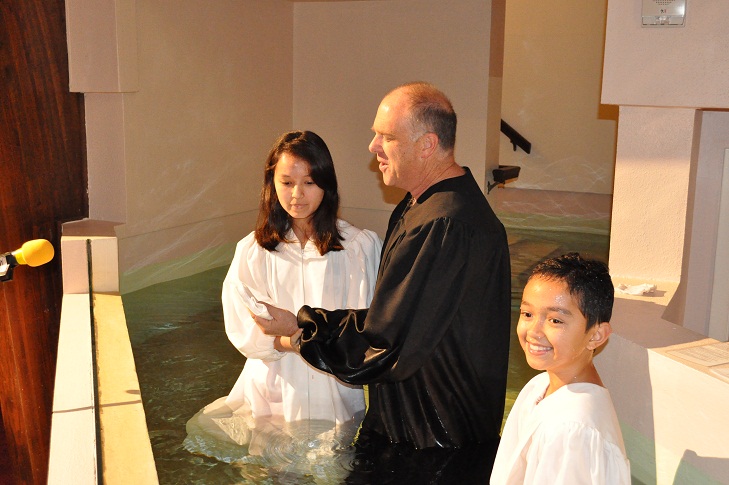
Go therefore and make disciples of all the nations, baptizing them in the name of the Father and of the Son and of the Holy Spirit, teaching them to observe all things that I have commanded you; and lo, I am with you always, even to the end of the age.” Amen. Matthew 28:19-20 NKJV
Many people ask, why the Seventh-day Adventist Church has people go though an entire series of Bible studies before baptism? It is because Jesus tells us to “teach them to observe all things I have commanded you.” This cannot be done in one or two sittings. So why did Philipp baptize the Ethiopian after just one Bible study? Keep in mind that the Ethiopian, as many people were in his time and place, was aware of the seventh-day Sabbath, clean and unclean foods, as well as other Bible standards. Even today there are people we may be baptized sooner than others because of what they have already learned. I have had people come to my church who have been watching programs like It is Written for several years, and as I interview them I find they are already quite capable of explaining many doctrines from the Bible. That allows us to move on to other topics they may not be as familiar with.
Baptism is a major decision in one’s life – even greater than marriage or a career, as being a baptized disciple of Christ will have a major impact on who we marry and even on the way we perform our work or careers. Just like we do not want to rush into marriage without knowing what we are doing, or choose a career without being properly trained and informed about everything that career includes and demands, we need to have a clear understanding of what it means to be a baptized disciple. Jesus tells us right up front this not a decision to be made nonchalantly.
A large crowd was following Jesus. He turned around and said to them, “If you want to be my disciple, you must, by comparison, hate everyone else—your father and mother, wife and children, brothers and sisters—yes, even your own life. Otherwise, you cannot be my disciple. And if you do not carry your own cross and follow me, you cannot be my disciple. “But don’t begin until you count the cost. For who would begin construction of a building without first calculating the cost to see if there is enough money to finish it? Luke 14:25-28 NLT
Of course we do not know everything when are baptized. We will be learning throughout eternity, but those considering baptism should be taught enough from God’s Word so they can count the cost and have a thorough enough understanding of what it means to be a baptized disciple of Christ.
Ministers who labor in towns and cities to present the truth should not feel content, nor that their work is ended, until those who have accepted the theory of the truth realize indeed the effect of its sanctifying power, and are truly converted to God. God would be better pleased to have six truly converted to the truth as the result of their labors, than to have sixty make a nominal profession, and yet not be thoroughly converted. These ministers should devote less time to preaching sermons, and reserve a portion of their strength to visit and pray with those who are interested, giving them godly instruction, to the end that they may “present every man perfect in Christ Jesus.” – Ellen White, Evangelism, Pages 320.
Over the years, as a lay person giving Bible studies and then as a Bible Worker and now as a pastor, my ultimate goal is not to see people get baptized. It is to see them enter the kingdom of heaven. As we all, lay members and clergy alike share the gospel and give personal and group Bible studies, our goal should be to study with each person in such a way as to encourage them to not only be baptized, but to be in the kingdom of God. Jesus Himself warns that many will make a nominal profession without ever being saved into His kingdom.
Not everyone who calls out to me, ‘Lord! Lord!’ will enter the Kingdom of Heaven. Only those who actually do the will of my Father in heaven will enter. On judgment day many will say to me, ‘Lord! Lord! We prophesied in your name and cast out demons in your name and performed many miracles in your name.’ But I will reply, ‘I never knew you. Get away from me, you who break God’s laws. Matthew 7:21-23 NLT
We need to be faithful while studying with those seeking baptism, in teaching them as Jesus said, “to observe all things I have commanded you,” so we can see them reach the ultimate goal of being with Jesus in His kingdom.
Blessed are those who do His commandments, that they may have the right to the tree of life, and may enter through the gates into the city. Revelation 22:14 NKJV
You may study this week’s Sabbath School lesson here.

 In Light of The Cross