Main Theme: John recounts the encounter between Jesus, the woman at the well, and the people of the Samaritan city of Sychar.
Read in Class: John 4:5-15. Ask the class the identify the main idea of this passage.
Study: How did Jesus use this opportunity to open a dialogue with the woman at the well? How does Jesus begin witnessing to this woman?
Apply: Read John 7:37-38. What is Jesus saying to us in these verses, and how do we experience what He is promising here?
Share: Your friend asks, “What are some of the taboos in your own culture that could hamper your witness to others? How do we learn to transcend them?” What do you tell your friend?
Study: How did Jesus respond to the woman’s request? What truth in Ezekiel 36:25-27 was Jesus trying to bring home to the woman?
Apply: In John 4:16 Jesus gets very personal with the woman to make her aware of her need for healing. How do we react when a friend or maybe even a sermon in church may expose an area where we need healing? Do we become defensive, or do we acknowledge our need for healing?
Share: Your friend asks, you how God has taken away your heart of stone and given you a heart of flesh? What do you tell your friend?
Read in Class:John 4:16-26. Ask the class to define the main idea of this passage.
Study: What did Jesus do to show this woman that He knew her deepest secrets, and how did she respond? How did Jesus reveal His identity to her?
Apply: What should this story tell us about why the gospel needs to break down the barriers that we humans create with each other?
Share: Your friend mentions how you can see a friend you have not seen in years, and once you get back together it was like you were never apart. Could it be because you had been together “in the Sprit” even while you were apart? What do you tell your friend?
Read in Class: John 4:27-42. Ask the class to define the main idea of this passage.
Study: What surprising action did the woman take?
Apply: What happened following this encounter, and what does it teach about how the gospel can be spread?
Share: What should this story tell us about how powerful the witness of even one person can be? How powerful a witness are you to what Jesus has done in your life? Who can you share your story with this week?
Jesus saw Nathanael coming toward Him, and said of him, “Behold, an Israelite indeed, in whom is no deceit!” John 1:47 NKJV
We don’t hear much about Nathanael before or after this story. Nathanael does not go on to be a world renowned preacher. If he wrote anything it was never published in the Cannon. There is no record of him parting the waters, or calling fire down from heaven. By all accounts he was just an ordinary guy, but wow, what an awesome affirmation he received from God. Before Nathanael met Jesus, Jesus already knew him by name and publicly recognized his integrity. I am more than happy to just remain a common ordinary guy, so long as I can hear Jesus one day say about me what He said about Nathanel. Such an affirmation coming from God means way more to me than all the worldly accomplishments and fame this world can give.
Nathanael is not the only “ordinary guy” that God knew by name and held in high esteem. In Exodus 31:1-6 God calls out Bezalel and Aholiab by name as the “construction workers” he wanted working on the temple. He even said they were filled with His Spirit, so God not only fills priests and pastors with His Spirit, He fills people in all walks of life. In Nehemiah 3:1-32 Nehemiah calls out several construction workers by name, who made repairs in rebuilding Jerusalem. A few weeks ago, Florida, where I live was hit by two hurricanes. Linemen came from all over the country, and even some from Canada to help restore electricity to our communities. All our churches were praying for these linemen. In Revelation 1:20 we see how Jesus holds His ministers in His hands, but I realized that God also knew these linemen by name and held them in His hands as well.
The world may have some kind of hierarchy, but we all stand on level ground at the foot of the cross and in the presence of God. God does not esteem us according to our fame or worldly status. We may be just ordinary folk to the world, but still be precious in the eyes and in the hands of God. I would gladly trade all the praise and esteem this world has to give just to hear Jesus say about me, “Behold, a man indeed, in whom is no deceit!” By God’s grace, no matter what our positions or worldly titles may be, no matter how common or ordinary we may appear, we may all hear Jesus tell us,
“Well done, good and faithful servant; you were faithful over a few things, I will make you ruler over many things. Enter into the joy of your lord.” Matthew 25:21 NKJV
You may study this week’s Sabbath School lesson here.
Main Theme: This week begins with the powerful witness of John the Baptist. Other witnesses come on the stage as well: Andrew and Simon Peter, Philip and Nathanael, and a most unexpected witness, the Pharisee Nicodemus. But another witness stands back in the shadows (that other disciple with Andrew, in John 1:35; John 1:40)—John himself.
Read in Class: John 1:19-23. Ask the class to define the main idea of this passage.
Study: How did John the Baptist explain his ministry and mission?
Apply: In what way should we, as Seventh-day Adventists, do the same kind of ministry as did John the Baptist? What are the parallels?
Share: Your friend asks you how John the Baptist knew Jesus was the Messiah? What do you tell your friend?
Read in Class: John 1:29-39. Ask the class the define the main idea of this passage.
Study: What proclamation does John the Baptist make about Jesus? What image does he use to depict Him, and why is it so significant in understanding who Jesus was and what His mission would be? What did these two disciples do after hearing John’s witness about Jesus?
Apply: Read Mark 10:45, Romans 5:6, and 1 Peter 2:24. How do these verses help us understand the role of Jesus as “the Lamb of God”? Consider deeply Jesus’ title as “the Lamb of God.” What images does it bring to mind, and how does its linkage to the Old Testament sacrificial system help you appreciate the great price of our salvation?
Share: Your friend asks, you, “In what ways has Christ, and your faith in Christ, changed your life? What other changes would you still like to see happen?” What do you tell your friend?
Read in Class: John 1:43-51. Have the class summarize this passage.
Study: What did Philip’s message reveal about his faith in Jesus already? How did Jesus convince Nathanael of who He was, and what was Nathanael’s response?
Apply: While we don’t hear much about or from Nathaniel other than this brief passage, Jesus spoke very highly of him. What does this tell you about how God regards those of us who live normal everyday lives?
Share: Your friend asks, what Nathaniel meant by “can anything good come out of Nazareth?” What do you tell your friend?
Read in Class: John 3:1-21. Ask the class the summarize this passage.
Study: How does the testimony of Nicodemus support the theme of the Gospel of John?
Apply: What did Jesus say to Nicodemus to show that He could see right through him?
Share: Your friend asks, “What does it mean to be “born again,” and why would Jesus put such emphasis on it?” What do you tell your friend?
In Genesis 2:16-17 ESV God says, “of the tree of the knowledge of good and evil you shall not eat, for in the day that you eat of it you shall surely die.” We all know Adam and Eve did not die the day they ate of the forbidden fruit. Man has been trying to make excuses for God ever since.
Some say, well they began to die. However that is not what God said. He did not say you will begin to die the day you eat of the fruit. He said you will die in the day you eat of the fruit. Others say, they died spiritually that day. I don’t even know what the means! Sounds profound enough, I guess, but what does it mean? Besides, God did not say you will die spiritually the day you eat of the fruit. He said you will die – drop dead the day you eat of it. So what kept Adam and Eve from dropping dead the day they ate of the fruit?
Instead of trying to make up weak excuses for God, let’s let God’s Word explain itself. He does not need any help from us to get out of this jam. We find the answer at the other end of the Bible. Revelation 13:8 tells us Jesus was the Lamb slain from the foundation of the world. There is our answer! God did not need us bailing Him out by making up our own theories about beginning to die or dying spiritually that day. Revelation 13:8 lets us know that Jesus’ death on the cross had already taken effect. God calls things that are not yet, as though they already were. Just like I can cut and paste, just as I am writing this post in Microsoft Word, God can cut and paste through time and eternity and put the cross at the foundation of the world.
Jesus is truly the Savior of the whole world, as His sacrifice sustains not only the believer but the unbeliever as well. Adam and Eve were not believers; they were running from God. But they still had their breath that day because of the cross of Christ and the Lamb slain from the foundation of the world. God told Abraham in Genesis 12:3, “and in thee [Abraham’s Seed which was Christ] shall all families of the earth be blessed.” Notice God said all families will be “blessed,” or benefit from the cross. That includes Christians, Jews, Muslims, and atheists. They all benefit the same way Adam and Eve did.
The reason Adam and Eve did not drop dead the same day they ate the fruit was because Jesus was the Lamb slain from the foundation of the world, and His death had already taken effect. The reason we do not drop dead the same day we sin, is because of the cross of Christ as well.
Believer and unbeliever benefit from the cross. This is what John was talking about in 1 John 2:2 ESV. He writes, “He is the propitiation for our sins, and not for ours only but also for the sins of the whole world.” John was writing to believers when he said “not for ours only,” the believers, but the whole world! An inspired writer, 1,800 years after John, echoes the same sentiments.
“To the death of Christ we owe even this earthly life. The bread we eat is the purchase of His broken body. The water we drink is bought by His spilled blood. Never one, saint or sinner, eats his daily food, but he is nourished by the body and the blood of Christ. The cross of Calvary is stamped on every loaf.” – Ellen White, Desire of Ages, page 660.
Every breath we breathe is brought to us courtesy of the cross. People curse God with the very breath that He died to give them!
This idea of Jesus beginning our redemption even at creation runs all through the Bible.
Then the King will say to those on his right, “Come, you who are blessed by my Father, inherit the kingdom prepared for you from the foundation of the world.” 9Matthew 25:34 ESV)
… even as he chose us in him before the foundation of the world, that we should be holy and blameless before him. In love. (Ephesians 1:4 ESV)
in hope of eternal life, which God, who never lies, promised before the ages began (Titus 1:2)
Yes! Jesus created the tree He knew would be used to make the old rugged cross. Even at creation He was beginning our redemption. He died to give us probationary time. Not a probationary time to see if God will accept us – He already has accepted us from the foundation of the world – but time to see if we will accept Jesus and His life-changing love.
If we choose to accept His love, Jesus tells us in John 11:26 ESV, “everyone who lives and believes in me shall never die. Do you believe this?.” Sure, we may fall asleep like Lazarus did, but God will not abandon us in the grave. We will not experience the death and God abandonment that Jesus experienced for us on the cross when He cried out, ‘My God, My God, why have you forsaken me!”
The cross echoes throughout time and space from every corner of eternity, telling us God is love! The Gospel begins at creation.
You may study this week’s Sabbath School Lesson here.
Main Theme: This week’s lesson will begin with the Prologue (John 1:1-18) and summarize its major themes. These themes will then be looked at in other places in John’s Gospel, as well.
Read in Class:John 1:1-5, 14. Ask Class to define the main point of these passages.
Study: What are these verses telling us that Jesus, God Himself, did—and why is this truth the most important truth that we could ever know?
Apply: Why is the full deity of Christ such an important part of our theology? What would we lose if Jesus were, in any way, a mere created being?
Share: Your friend says, If Jesus knew Lucifer was going to sin, and cause Him to have to die on the cross, why did He even bother creating Him? Jesus should have only created people who would use their free choice to obey Him. What do you tell your friend?
Read in Class:John 1:9-13. Have the class define the main idea of this passage.
Study: What harsh reality is John depicting here about how people respond to Jesus?
Apply: In what ways might we, even those of us in the church reject Jesus today? How do we make sure we are not rejecting Him?
Share: Your friend asks you How has your life changed by becoming a son or a daughter of God? What do you tell your friend?
Study: How do these texts repeat the theme of belief/unbelief found in the prologue?
Apply: In what ways do you live out your faith in Jesus, as opposed to merely holding an intellectual assent to Him as the Messiah? Why it is important to know the difference?
Share: Your friend asks, why Isaiah says that God blinded peoples eyes and hardened their hearts? What do you tell your friend? See Matthew 7:21-23.
Read in Class: John 17:1-5. Ask the class to define the main point of this passage.
Study: What did Jesus mean when He said, “Father, the hour has come; glorify your Son that the Son may glorify you” (ESV)?
Apply: Think about what it means that it took such a drastic thing, God Himself on the cross, to save us from sin. What should this tell us about just how bad sin really is?
Share: How can you use your influence to help those around you believe in Jesus as the Messiah and Savior of the world?
Main Theme: This week’s lesson looks at three of the greatest signs of Jesus’ divinity. What is striking is that, in every case, some people did not believe the miracle or perceive its significance. For some, it was a time of turning away from Jesus; for others, a time for deepening blindness; and for others, a time to plot Jesus’ death. And for others—a time to believe that Jesus was the Messiah.
Read in Class: John 6:1-14. Ask the class the summarize this passage.
Study: What parallels can be found here between Jesus and Moses? That is, what did Jesus do here that should have reminded the people of the deliverance that their ancestors had received through the ministry of Moses?
Apply: Read Isaiah 53:4-6 and 1 Peter 2:24. What great truth do these texts teach about Jesus as the Lamb of God? How does His divinity tie into this truth, and why is this truth the most important truth we can ever know?
Share: Your friend asks, you how God has provided for you in a way that helped you see His miraculous power? What do you tell your friend?
Read in Class:John 6:26-36. Ask Class to summarize this passage.
Study: How did the people respond to Jesus’ miracle of feeding the multitude, and how did Jesus use this to try to teach them who He was?
Apply: How can we avoid getting caught up in material things at the expense of the spiritual?
Share: Your friend from church complains that some people only come to church when there is fellowship lunch and they don’t even bring anything. All some people come to church for is the socials and food. What do you tell your friend?
Read in Class: John 19:1-16. Ask clas to summarize this passage.
Study: What did the disciples think was the cause of this man’s blindness, and how did Jesus correct their false beliefs?
Apply: What should this story tell us about the dangers of being so blinded by our own beliefs and traditions that we can miss important truths right before our own eyes?
Share: Your friend says there seems to a lot of division in our world today. How can we tell if someone is a good person or not when we keep hearing rumors all the time? How do we know what to believe about people? What do you tell your friend?
Read in Class: John 11:38-44. Ask the class to define the main point of this passage.
Study: What did Jesus do that supported His claim?
Apply: What hope does the divinity of Christ give you concerning death? Why are both his humanity and divinity so crucial in validating your hope?
Share: Your friend says he is sure Jesus was a good man, but He was not God? What do you tell your friend?
“For Christ’s love compels us…..” 2 Corinthians 5:14 NIV
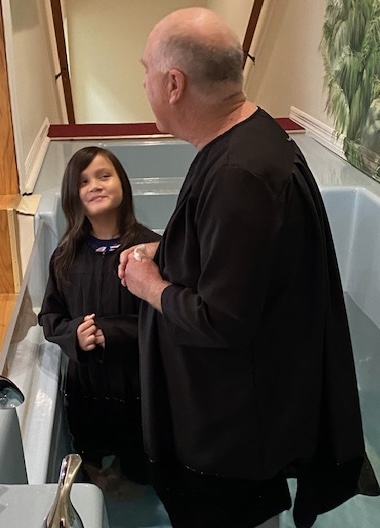
Around the world, some children get baptized and are given a celebration dinner with nice gifts.
Around the world, other children get baptized and get beaten by their parents and disowned by their family.
Around the world this month, some pastors will be given warm greeting cards, with beautiful gifts.
Around the world this month, other pastors will be persecuted and killed for sharing the Gospel.
It’s not a fair world, is it? One child being celebrated by her family when being baptized, and another child being disowned by her family when baptized. One pastor is lauded by his church family while another pastor is condemned by his church family while both are doing the same job. This is where we need to remember why we do what we do. Is it for gifts and rewards? Is it for praise and appreciation? Or does the love of Christ compel us to be baptized and share the gospel with the world? These words of Jesus are for anyone who follows Him. They are for free United States citizens as well as those in communist countries.
Then He said to them all, “If anyone desires to come after Me, let him deny himself, and take up his cross daily, and follow Me. Luke 9:23 NKJV
I was baptized over 50 years ago, and since then have totally lost my baptism certificate. I think of this every time I baptize someone and given them their certificate. But Christ did not give his followers certificates. He did not give them a nice Hallmark card congratulating them for their decision. He did not give them a nice devotional book as a gift. He gave them a cross to go die on.
It is not the fear of punishment, or the hope of everlasting reward, that leads the disciples of Christ to follow Him. They behold the Saviour’s matchless love, revealed throughout His pilgrimage on earth, from the manger of Bethlehem to Calvary’s cross, and the sight of Him attracts, it softens and subdues the soul. Love awakens in the heart of the beholders. They hear His voice, and they follow Him.-Ellen White, Desire of Ages, Page 480.
I have shared the story before how years ago I was at an awards banquet for literature evangelists, when I fist started canvassing. I was mesmerized by the plagues and trophies –I wanted one so bad. So I went and worked hard all year to earn my trophy, and by the ed of the year I had led my conference in sales. I was so disappointed when the conference canceled the awards ceremony that year! I became bitter. But a while after that I found myself in an old cemetery. As I walked around, reading the words on each gravestone, I felt the Holy Spirit asking me, “Why are you alive today, William?” After considering this question and all the suffering that is going on in the world, I realized I was not alive to win trophies and awards. I was alive to share the hope of the Gospel with a hurt and dying world. The words of an old hymn suddenly had new meaning,
Till my trophies at last I lay down; I will cling to the old rugged cross,
Alone in that cemetery that day I understood, Jesus was not handing out plaques and trophies. He was not handing out gift cards and greeting cards. He handed me a cross to die on. In that cemetery I gained a clear vison of my calling. Trophies, plaques and gift cards can’t forgive sins or heal broken hearts. They can’t give hope to a dying world. I picked up my cross to follow Jesus.
Later I became a Bible Worker and served many years in three conferences, until one day a couple of years back I got a call from the Florida Conference to pastor a three-church district. Many of my friends and family celebrated this call. I greatly appreciated the encouragement. However I realized once again, I have been given a cross. My three congregations have been very wonderful to me. They encourage me when I do well, and they are graceful when I fail. Either way – no matter how I do – they love me because Jesus’ love is in their hearts. I realize not all pastors have loving congregations. While I am being loved even though I made a big mistake other pastors are being persecuted while doing exactly what was right.
This month is pastor appreciation month around the world. As a pastor who is loved unconditionally by God and my three churches, I encourage us all this month to be mindful of those who are serving under persecution. Let’s also remember those who serve as lay pastors while also working at a vocation to support themselves instead of being paid by the church. They work hard for their churches and do just as good a job as full time conference paid pastors. They make a sacrifice by working hard at a vocation and then also working hard for their church. Let’s also remember the children who are being persecuted for their faith in Jesus. There are children who have tasted persecution for their faith, like this pastor has never tasted. I have a comfy job as a pastor in the United States, while there are children who could preach sermons about their personal experiences with persecution that would put me to shame. And yes, please give what you can in ways of support to these worthy ministers. Since I am already spoiled, and have way more than I deserve, for pastor appreciation month instead of giving gifts to me, please send a donation to the Seventh-day Adventist Chinese Union Mission (You will probably want to click on or touch the “EN” at the top right corner. of the page to see the English-language site.) On the donation link there is a section called “other.” I have been told by a pastor near that area that you can write, “persecuted missionaries” in that section and they will get it to help those being persecuted.
I can’t speak for all pastors in the United States, but what I need more than anything is words of inspiration and to know that you are praying for me. As far as gift cards go, there are persecuted pastors around the world who need and deserve your monetary gifts much more than I do. Let’s make sure all the pastors, lay pastors, missionaries, and lay evangelists get the love and support they need this month and always.
You may study this week’s Sabbath School Lesson here.




 In Light of The Cross