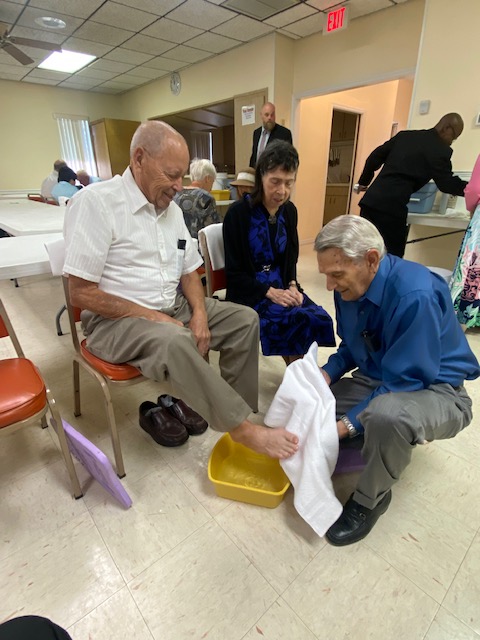
Humility is not Humiliating

Jesus taught humility while upholding human dignity.

So He told a parable to those who were invited, when He noted how they chose the best places, saying to them: “When you are invited by anyone to a wedding feast, do not sit down in the best place, lest one more honorable than you be invited by him; and he who invited you and him come and say to you, ‘Give place to this man,’ and then you begin with shame to take the lowest place. But when you are invited, go and sit down in the lowest place, so that when he who invited you comes, he may say to you, ‘Friend, go up higher.’ Then you will have glory in the presence of those who sit at the table with you. For whoever exalts himself will be humbled, and he who humbles himself will be exalted.” Luke 14:7-11 NKJV

Here, Jesus teaches us how to be humble and how to protect ourselves from humiliation. By assuming the lowest place, we avoid being humiliated by being asked to step down. While the gospel destroys human pride, Jesus protects human dignity. After all, in John 2:1-10, Jesus turns water into wine and performs His first miracle to save a host from embarrassment. In John 8:1-11, Jesus protects the dignity of a woman tricked into adultery, while also protecting the dignity of the accomplices by writing in the sand instead of publicly calling them out. We don’t know exactly what Jesus wrote in the sand, and it makes me wonder whether Jesus told John not to tell anyone what he read that day, to protect the dignity of those He was striving to convert. If so, Revelation 10:4 would be the second time John was told not to write what he heard or read. But I digress.

Jesus taught us how to be humble without being humiliated. To me, the difference between humility and humiliation comes down to control. We humans love to be in control of ourselves, and that is not all bad. After all, according to Galatians 5:22-23, self-control is a fruit of the Spirit. So, self-control is a good thing, and Jesus teaches us how to be humble while still being in control of ourselves.

When I was 11, several family members were at my grandmother’s house for a funeral. Everyone was receiving their sleeping arrangements, and after my grandmother checked to make sure everyone was okay with their bedding, she turned to me and said, “The only place left for you is the sofa in the living room.” While I was happy to sleep on the sofa, or floor for that matter, I was insulted and humiliated that I was told instead of asked. Especially since everyone else, including other children, were asked. I wanted the dignity of being in control and volunteering to sleep on the sofa instead of being forced.

Looking back at the situation with adult eyes now, I understand the people, including children, who were asked where they wanted to sleep were more directly related to the dearly departed than I was. Also, my grandmother was grieving the loss of her sister, so I could have been more understanding. I could also have spoken up earlier and said I would just sleep on the sofa or anywhere. But hey, I was just a kid. The point is, I understand what Jesus was talking about when He taught us to exercise self-control and take the lowest place before it is assigned to us, and we lose control. I hope I have also learned how to protect the dignity of younger people while teaching them humility. Humility should not be humiliating. Desiring that type of control is not a sin. Remember, the Holy Spirit gives us self-control.

A friend told me that when she was new to a company, and on a business flight, she did not realize she had taken the vice president’s seat. It was later pointed out to her by a seasoned associate towards the end of the flight. However, when the vice president saw a new intern sitting in his seat, he said nothing and went to the back of the plane, taking the last seat left. He did not want to embarrass a new employee, and besides, he not only had self-control but also the self-confidence to realize that the vice president’s seat was whatever seat he was sitting in.

In the Book of Esther, Haman could have learned a lesson from this vice president and saved his neck instead of getting all bent out of shape when Mordecai did not bow to him. On the other hand, Daniel exercised self-control when he was insulted by the king in Daniel 5:13. Daniel had enough self-confidence that he could let that insult roll right off his back.

Remember, when weak people are disrespected, they seek revenge. When people who are strong in the Lord are disrespected, they forgive. When brilliant people are disrespected, they ignore the disrespect.

Fools show their annoyance at once, but the prudent overlook an insult. Proverbs 12:16 NIV

The gospel destroys human pride while protecting human dignity. Using self-control to be humble is not humiliating. Failing to use self-control to be humble is humiliating.

You may study this week’s Sabbath School lesson here.

4: Unity Through Humility-Sabbath School Lesson Teaching Plan

Photo by Magda Ehlers on Pexels.com

Prepared by William Earnhardt for Sabbath School Class, January 24, 2026.

Central Theme: This week, we’ll look at the biblical basis for unity in the church, focusing especially on the amazing condescension of Jesus, the lessons we can gain from beholding Him, and how we can grow to be more like Him.

Read in Class: Philippians 2:1-4. Ask the class to summarize this passage.

Study: What factors seem to have led to disunity within the church? What practical steps does Paul urge to have unity in the church?

Apply: What kind of death to self would lead us to where we, indeed, esteem others better than ourselves? How can we learn to do that? How different would our relationships be if we all lived like that?

Share: Your friend asks you if you have ever known anyone who was so humble that it reminded you of Jesus? What do you tell your friend?

Read in Class: Philippians 2:5.

Study: What do you think it means to have the “mind” of Christ?

Apply: Why is it so important that we follow what Paul tells us here: “Finally, brethren, whatever things are true, whatever things are noble, whatever things are just, whatever things are pure, whatever things are lovely, whatever things are of good report, if there is any virtue and if there is anything praiseworthy–meditate on these things” (Phil. 4:8, NKJV)?

Share: Your friend says that we are all human, so there is no way we can really have the mind of Christ. What do you tell your friend? Hint: See Romans 12:1-21.

Read in Class: Philippians 2:5-8. Ask the class to identify the main idea of this passage.

Study: What is Paul saying to us here? What are the implications of these words? Most importantly, how do we apply the principle expressed here to our own lives?

Apply: How should we respond to what Christ has done for us, as depicted in Philippians 2:5-8? What response could possibly be “adequate” or worthy of what Christ has done for us, perhaps other than to fall on our knees and worship? Why is it so wrong to think that our works can add to what Christ has already done for us?

Share: Your friend says he thinks the reason so many people have trouble being humble is that they think it is humiliating to be humble. Is there a difference between being humble and being humiliated? What do you tell your friend?

Read in Class: Romans 8:3, Hebrews 2:14-18, and Hebrews 4:15.

Study: What characterized Jesus’ condescension and His taking of human nature?

Apply: How can, and should, focusing on what Jesus did for us at the cross–seeing the cross as our example of surrender and humility–make us more humble, as well as more submissive to God?

Share: Your friend says, 1 Corinthians 8:2 says, “And if anyone thinks that he knows anything, he knows nothing yet as he ought to know.” Your friend asks what that is saying. Does it mean we are not supposed to act like we know anything? What do you tell your friend?

Mission: Ask yourself what specific changes you can make to show more humility at your work, school, church, and family. Share these specific changes with God and ask for His help.

Through Jesus, we Can Fulfill Our Destiny

For to me, to live is Christ, and to die is gain. Philippians 1:21 NKJV

Paul felt the destiny of his life was to share the Gospel, even if it meant facing constant persecution and even death. 

And now I am bound by the Spirit to go to Jerusalem. I don’t know what awaits me, except that the Holy Spirit tells me in city after city that jail and suffering lie ahead. But my life is worth nothing to me unless I use it for finishing the work assigned me by the Lord Jesus—the work of telling others the Good News about the wonderful grace of God. Acts 20:22-24 NLT 

Thankfully Paul’s life was preserved until he accomplished everything Jesus wanted him to accomplish.

Satan is constantly trying to attack those who share the Gospel, just as he constantly tried to attack Jesus Himself. It started with Herod trying to kill Jesus as a baby, and even His own church trying to throw Him off a cliff, as well as trying to stone Him to death. But there was no way Jesus or Paul could die until they accomplished their destiny for living. 

Likewise, even if our lives are cut short, we can be certain Jesus will not let that happen until He has accomplished His purpose for our lives. Here is a remarkable account of Ellen Harmon, a young girl, no more than eighteen years old. She is on a steamboat leaving Portland Maine that has just run into a very dangerous storm. While many were fearful for their lives, this young girl, when asked by an older woman why she was not afraid like everyone else, could answer with assurance:

“I told her I had made Christ my refuge, and if my work was done, I might as well lie in the bottom of the ocean as in any other place; but if my work was not done, all the waters of the ocean could not drown me. My trust was in God, that he would bring us safe to land if it was for his glory.” Ellen White, Life Sketches, p. 241

God did indeed have a work for Ellen to do. Ellen later married James White, an Adventist pioneer, and the rest is history. God also has a purpose for each of us. Our goal in this world should not necessarily be to live a long life, but to live a faithful life. As long as we have the assurance young Ellen had, that we are in God’s care and doing God’s work, the longevity of our life is not consequential, and we shall be prepared to walk away from this world either by death or the Second Coming at any time, satisfied we have accomplished our purpose and destiny as followers of Christ. 

Each has his own experience, peculiar in its character and circumstances, to accomplish a certain work. God has a work, a purpose, in the life of each of us. Every act, however small, has its place in our life experience. – Ellen White, God’s Amazing Grace, Page 311

You may study this week’s Sabbath School lesson here.

3: Life and Death-Sabbath School Lesson Teaching Plan

Prepared by William Earnhardt for Sabbath School Class, 17 January 2026.

Central Theme: Life is short, and it is vital to make the greatest possible impact for God’s kingdom within the years God grants us.

Read in Class: Philippians 1:19-20. Compare with Galatians 4:19.

Study: What seems to be Paul’s expectation as to the outcome of his trial? What does he consider even more important than being acquitted? What did Paul want to see accomplished in the people he won to Christ?

Apply: Look at how you live and how you treat people, especially people who don’t treat you nicely. What kind of witness for Jesus do you present?

Share: Your friend says, “Isn’t making sure we have eternal life the whole purpose of accepting Jesus as our savior? So why would Paul not care if he lived or died so long as Christ is magnified? Is there more to the cross and salvation other than just making sure we get eternal life?”

Read in Class: Philippians 1:21-22 and 2 Corinthians 10:3-6.

Study: What is the basis of the spiritual war we wage, and what are our weapons? How do we understand Paul’s point, especially in the context of the great controversy?

Apply: In what ways, right now, are you experiencing the reality of the great controversy? How can you draw comfort and strength from knowing that Christ has won the victory for us already?

Share: Your friend asks, “What does it mean, ‘To me to live is Christ and to die is gain?” What do you tell your friend?

Read in Class: Philippians 1:23-24.

Study: What does Paul mean when he says that “to depart, and be with Christ” is “far better”?

Apply: Knowing that our days in the flesh here on earth are numbered, how can we make the best use of our time to share the Gospel, especially those of us who are working full-time jobs or are in school full-time?

Share: Your friend says that Philippians 1:23-24 proves that we go straight to heaven the moment we die. What do you tell your friend? For a hint, see what Paul says later in Philippians 3:10-11.

Read in Class: Philippians 1:27-30 and John 17:17-19.

Study: What do both Jesus and Paul say is indispensable for unity in the church? How does our unity and “striving together for the faith of the gospel” relate to fearlessness?

Apply: What hope, what comfort, should we, as Christians, have amid our suffering?

Share: Your friend says she has noticed that people in the church who work together to spread the Gospel don’t seem to bicker, complain, or gossip as much as those who aren’t working in the church to spread the Gospel. Do you agree with your friend? How do you respond to your friend?

Mission: Can you think of someone who works a full-time job or goes to school full-time, and still makes good use of their time sharing the Gospel? Can you reach out to them this week and encourage and affirm their ministry? Maybe even pray with them that God will continue blessing their ministry?

Are You Willing to be Imprisoned for Jesus?

Photo by Pixabay on Pexels.com

But I want you to know, brethren, that the things which happened to me have actually turned out for the furtherance of the gospel, Philippians 1:12 NKJV

While no one wants to go to prison, especially if falsely accused of a crime they did not commit, would it be worth it to you to be falsely accused and sentenced to jail if you could lead just one person there to eternal salvation? 

In Philippians, Paul says that his imprisonment actually helped spread the Gospel and encouraged others to be bold in spreading it. Acts 16 also mentions Paul and Silas being imprisoned in Philippi. They were singing songs of praise while the other prisoners were listening. If you were wrongfully imprisoned, would you be singing songs and praising God? I hope so, because something extraordinary happened. An earthquake opened up the prison. Instead of running for it, Paul and Silas ministered to the correctional officer and led him to salvation. You can read this fantastic story in Acts 16:25-34

Much more recently, the Christian Post, among other Christian news agencies, has shared the testimony of a Chinese woman known as Sister Tong. Chinese officials arrested her for having an underground church in her home. After serving her 6-month sentence, instead of complaining, she was beaming with joy about the women’s ministry she had begun right there in prison. Like Paul, being in prison helped sister Tong spread the Gospel and has inspired others in countries where Christianity is illegal to be bolder in spreading it as well. 

When you consider that Jesus left heaven to come to this cold, dark world to live and die to save others eternally, is there any place that is too cold or dark for you to go and save others? Jesus did not complain about coming to this cold, dark world to live and die, but came willingly. See John 10:17-18. Likewise, Paul and Silas were not protesting or pleading their innocence while in prison. They were praising the Lord. What a testimony to the warden and other prisoners! And more recently, instead of complaining about the terrible living conditions in a Chinese prison, Sister Tong beams with joy over being able to lead several women prisoners to Jesus and salvation. 

Paul, Silas, and Sister Tong not only endured prison and persecution to save others eternally, but did so joyfully. Is there any place you are unwilling to go joyfully to lead others to eternal salvation? 

You may study this week’s Sabbath School lesson here.

2: Reasons for Thanksgiving and Prayer-Sabbath School Lesson Teaching Plan

Prepared by William Earnhardt for Sabbath School Class, Sabbath, 10 January 2026.

Central Theme: This week, we’ll consider Paul’s opening words of thanksgiving and prayer in Philippians and Colossians, which may enrich and strengthen our own prayer life.

Read in Class: Philippians 1:3-8. Ask the class to summarize this passage.

Study: What is Paul thankful for? What reassurances does he give the Philippians, and why is that important?

Apply: How do you understand the promise that God will finish the “good work in you” (Phil. 1:6)? What does that mean? Will this work ever end before the Second Coming?

Share: Who are some people in your life that you thank God for, and why?

Read in Class: Philippians 1:9-11. Ask the class to identify the main idea of this passage.

Study: What is the focus of Paul’s prayer, and what big requests does he make? What does it tell you about prayer?

Apply: Whatever else we do, how can our love “abound still more and more” (Phil. 1:9, NKJV)? Why is that so important for the Christian life? (See also 1 Cor. 13:1-8.)

Share: Your friend says that she tries to be sincere and not offend others, but the people she works with are too sensitive and easily offended. What do you tell your friend?

Read in Class: Philippians 1:12-18. Ask the class to summarize this passage.

Study: How did Paul view his imprisonment? What lessons can we learn from his attitude, despite the circumstances he found himself in?

Apply: What lesson have you learned from experiences that, though unquestionably bad, also brought about some benefits? Even in cases in which a benefit might not be apparent, how can we learn to trust God regardless?

Share: Your friend asks, “What selfish motivations could possibly drive someone to share the gospel, and how should we respond to them?” What do you tell your friend?

Read in Class: Colossians 1:3-12. Ask the class to summarize this passage.

Study: What three things does Paul thank God for? What specific requests do you find in Paul’s prayer?

Apply: In Colossians 1:5, Paul writes about “the hope which is laid up for you in heaven.” What is your understanding of that hope, and why does it apply to you personally, even though you are truly unworthy?

Share: If someone were to ask you, “How do you know that God is leading you in one direction or another?” how would you answer–and why?

Mission: Can you reach out to someone this week who is going through a tough time and offer encouragement?