Study: As we study the book of Joshua, we see that Joshua understood his battles were part of a larger conflict. What do we understand about the battles that involved God Himself?
Apply: What are ways we see, in the world around us and in our own lives, the reality of this cosmic battle between good and evil?
Share: Your friend asks, Why would God command Joshua to fight in wars with physical violence? Wasn’t the war in heaven just a “spiritual war?” What do you tell your friend?
Study: What do you learn about the identity of the commander of the Lord’s army?
Apply: What comfort can, and should, we draw from knowing that the “Commander of the army of the LORD” is at work in defense of His people?
Share: Your friend asks, How do we know the commander of the Lord’s army is Jesus? I thought it was Michael who was an angel? What do you tell your friend? Hint: See Michael My Savior.
Read in Class: Exodus 14:13-14, 25. Ask the class to identify the main idea of this passage.
Study: What was God’s original and ideal plan concerning the involvement of the Israelites in warfare?
Apply: “If the children of Israel had not murmured against the Lord, He would not have suffered their enemies to make war with them.”—Ellen G. White, The Story of Redemption, p. 134. How might murmurings impact our lives today?
Share: Your friend asks if it is murmuring and complaining against God when we complain about conference leaders or local church leaders. What do you tell your friend?
Study: What similarities do you find between these two war narratives? How do they differ?
Apply: Many times we want to see who’s on our side in a disagreement, but how can we stand still and wait for the Lord to fight for us in our spiritual battles?
Share: Can you think of someone who is in the middle of a spiritual battle right now? Can you take some time to intercede and pray for them right now?
“We have nothing to fear for the future, except as we shall forget the way the Lord has led us, and His teaching in our past history.”—Ellen G. White, Life Sketches, p. 196.
Long before Sabbath School Net, my blogsite, and Facebook, I loved to write. When I was a teenager, Earl Hamner inspired me to write and keep a journal. You may or may not know that Earl Hamner created the 1970s TV series The Waltons, based loosely on his own family’s experiences growing up during the Great Depression and World War II. In the TV series, John Boy, the character is based on Earl Hamner, who kept a journal. This inspired me to keep a journal, hoping to write some exciting stories to share later in life. While I did not write anything noteworthy enough to create my own TV series, I did write what has become a gold mine for my own reflection and self-discovery.
For instance, when I was 15, I had a crush on a girl who didn’t return my feelings, so I wrote in my journal that I had called her a snob to her face. A couple of weeks later, I recorded in my journal that I preached my first sermon, but also noted the girl I had a crush on did not come to hear me preach, and I wondered why. Reading my journal years later, it was blatantly obvious why. Just a few days earlier, I called her a snob. Who wants to hear someone preach who just called you a snob? I didn’t see the obvious at the time, but years later, reading my journal, I could connect the dots that I couldn’t connect at the time. Around the same age, I wrote in my journal how I hoped to become a pastor someday. It is rewarding to go back to my journal and read about dreams that were fulfilled years later. Except now I don’t call people I want to share the Gospel with “snobs.”
Sadly, after a couple of years of journaling, I stopped because I didn’t feel that what I wrote was exciting enough to record. Was I ever wrong! As I said earlier, I look back and see it as a gold mine of self-reflection and self-discovery, as well as documenting events and dates to refer back on whenever I need a timeline. By reading my old journals, I can see now what I have required to grow and how I have grown. Around 2005, Someone gave me a journal as a birthday gift, and I started journaling again, though I do not write in it nearly as often as I did as a teen. Of course, I now write on my blog and Facebook, so I can still share stories of my life.
As we study this week’s Sabbath School Lesson, “Memorials of Grace,” I am reminded how journaling can be a memorial of grace. In recent years, I have journaled about how God closed the door on my Bible Worker ministry only to open an even bigger door for ministry. I have journaled about how God got me out of debt after I lost my job, which is a very unique route out of debt. I have journaled about how God revealed His presence to me when my mother passed away. These miracles in my past are recorded in my journal to remind me that I never have to fear bad news.
They do not fear bad news; they confidently trust the Lord to care for them. Psalm 112:7 NLT
So today, I thank God for the gift of writing, whether it is in my personal journal or blogging on Sabbath School Net or social media. I hope you also take advantage of the wonderful gift of writing, and record your own tragedies and triumphs, so you can look back and read and re-read the wonderful things the Lord has brought you through and done for you. I feel that, like me, you will also learn some things about yourself as you read your old stories.
By the way, at camp meetings and while traveling, I will meet people who tell me they have been following my blog for a long time. Some of them have never commented, so I had no idea they were even following me. So, whether you have commented or not, I want to thank you for reading my blogs. Thank you for being someone I can share my stories with. By sharing my stories with you, I have been able to share my life with you. That makes you very special to me. Thank you.
Study: Why did God ask the Israelites to specially prepare for what was about to happen?
Apply: God does not always part the Jordan. His interventions are not always so obvious. How do you think we can develop the spiritual preparedness to experience and discern God’s interventions on our behalf?
Share: Your friend asks why God doesn’t perform amazing miracles anymore, like He did in Moses and Joshua’s day. What do you tell your friend?
Read in Class:Joshua 3:6-17. Ask the class to identify the primary meaning of this passage.
Study: What does the miraculous crossing of the Jordan tell us about the nature of the God whom we serve?
Apply: Read Luke 18:18-27. How does Jesus’ answer to His disciples encourage you to trust God with what seems impossible?
Share: Your friend asks you if you have ever seen God do anything in your life or the life of anyone you know that seemed impossible. What do you tell your friend?
Read in Class: Joshua 4. Ask the class to identify the primary meaning of this passage.
Study: Why did God ask the Israelites to build a memorial?
Apply: Read Psalm 45:17. What are some of the memorials, personal memorials, from your own walk with the Lord that help you remember what He has done for you? Why are these memorials so important?
Share: Your friend points out that despite God performing many amazing miracles for the children of Israel, they still complained and panicked whenever a new crisis arose. Your friend asks, What could have kept them from panicking all the time? What keeps you from panicking when a crisis occurs? What do you tell your friend?
Study: Why must we always remember what Christ did for us? What else really matters without it?
Apply: Though it is important to remember the past and how the Lord has worked in your life, why must you day by day have an experience with Him and the reality of His love and presence now?
Share: Can you think of someone who would be encouraged by your testimony about something amazing God has done to help you? Can you reach out to this person this week and share?
There is a saying, “kids who are loved at home come to school to learn. Kids who are not loved at home come to school to be loved.” Is it any different in Sabbath School? Is it also true that God’s children (ages 0-125) who know they are loved come to Sabbath school to learn, and those who don’t yet know they are loved come to Sabbath School to be loved?
I can still remember sitting at my desk in my 4th-grade classroom at Tulsa Adventist Academy, listening to my teachers, Miss Fisher and Mrs. Krueger, lecturing us about something. I don’t really remember exactly what it was about, but we must have been struggling with our grades, because all I remember is that both teachers told us, “If you only learn one thing this year, learn this. We love you!” Now we were loved at home. We were loved at church and school, but as educated as my teachers were, they knew the most important thing was not money or a degree. It’s love. Without that, nothing else matters, and when you know you are loved, nothing can stop you!
For the love of Christ controls and compels us, because we have concluded this, that One died for all, therefore all died (2 Corinthians 5:14 Amplified Bible)
So while humanity tries harder, and reads self-help books and tries 12-step recovery programs, Paul says it is by looking at the cross and knowing we are loved that we get all our power to succeed. I remember John the Baptist telling everyone to “Behold the Lamb of God who takes away the sins of the world. John 1:29. He didn’t tell them to try harder next time. He told them to look at the Lamb. Let His love soak into you.
As legalistic humans we are always wanting to promise to try harder next time. But the answer is not promising to try harder. The answer is letting yourself be loved.
In Jeremiah God mentions how Israel had not kept the promises they had made, so He was going to make a better promise. His promise would be better because He is the the One making the promise instead of them. He is the perfect Promise-maker while we are lousy promise-makers!
“But this is the new covenant I will make with the people of Israel after those days,” says the Lord. “I will put my instructions deep within them, and I will write them on their hearts. I will be their God, and they will be my people. (Jeremiah 31:33 NLT)
So God promises to do for us what we could never even promise to do for ourselves, much less even try harder to make happen. God is the One promising, and He is the One who is accountable to make it so. Please notice something very important though. Its in Jeremiah 31:3 NLT, several verses before He promises to write His law on our hearts.
I have loved you, my people, with an everlasting love. With unfailing love I have drawn you to myself.
Just like my teachers realized all the book knowledge in the world doesn’t mean a thing without love, God feels the same way. Knowing all the laws and having them memorized in your mind and knowing them all by heart doesn’t mean a thing if you don’t know how much God loves you!
Friends, there is no reason for you to promise God you are going to try harder and do better next time. He has already promised you! We don’t need to promise God what He has already promised us! What? I don’t have any work to do myself? Well yes, and I will let Jesus tell you Himself, exactly what your work is.
Jesus told them, “This is the only work God wants from you: Believe in the one he has sent.” John 6:29 NLT
Our work is to believe God’s promise that He loves us with an everlasting love, and He will place the principles of His love (also known as His law) in our hearts!
This is why John never told us to try harder! Just look at the Lamb and let His love soak into your heart till your heart is saturated with His love, which is also His law. You don’t need to promise God anything. Your work is to believe the promises God has made to you!
I don’t need too many self-help books. I don’t need to try harder. I just need to look at the Lamb and fall in love with Jesus! His love will change me in ways I could never change myself. After all, all the self help books and promises of better performance don’t mean a thing without love!
So just how good is God at keeping His promises to love and save us? For brevity, let me share one example. You can read about it in Joshua 9-10.
The Gibeonites used deceit to trick Israel into letting them in on the covenant God had made with them. Even though Israel was not supposed to make a covenant with anyone living as close as the Gibeonites, they did. Later when the Gibeonites were under attack, they called upon Israel to save them, and even though the Gibeonites had used deceit to secure this covenant, God was so relentless in keeping His promise of love, that He caused the sun to stand still until the Gibeonites were all rescued! God fought for Israel as Israel fought for the mischievous Gibeonites. Let that soak in. The Gibeonites were in no way worthy of any of God’s blessings, but God was still so loving and faithful to His promise that He made the sun stand still until they were all rescued! Talk about a love that moves heaven and earth! And this powerful love was given to the most undeserving people! So, scientifically speaking, the greatest power in the universe is not gravity or the suctioning power of the black hole. God’s love overruled all those powers and made the solar system stand still. Imagine what this love can do in your heart!
God’s powerful promises and love are also for you and me. In Hebrews 13:5 God promises to never leave us or forsake us, but the Amplified Bible is the only English version that even begins to grasp what God is actually promising.
for He has said, “I will never under any circumstances desert you nor give you up nor leave you without support, nor will I in any degree leave you helpless, nor will I forsake or let you down or relax My hold on you- assuredly not!” Hebrews 13:5 Amp version.
If we know we are loved we can come to Sabbath School to learn, and we can learn while we are loved, but we can’t learn without love.
If I had the gift of prophecy, and if I understood all of God’s secret plans and possessed all knowledge, and if I had such faith that I could move mountains, but didn’t love others, I would be nothing. 1 Corinthians 13:2 NLT
Main Theme: We explore two of the most fascinating stories of the book of Joshua and discover their relevance to our faith today. God’s grace has infinite possibilities to surprise us.
Study: Why would Joshua start the mission of conquering the Promised Land by sending out spies?
Apply: Read John 18:25-27 and John 21:15-19. What parallels do you discover between the second chance given to Israel as a nation and to Peter as a person? When has God given you a second chance, and how did you react?
Share: Your friend asks, since God gave Israel and Peter second chances, does that mean we have to give everyone a second chance? Where do we draw the line between how many times we give someone another chance and who we give second chances to? What do you tell your friend?
Study: What do these passages tell us about Rahab and God’s grace towards Rahab?
Apply: What does this story teach us about how God must have our ultimate allegiance?
Share: Your friend asks, Why did God honor Rahab’s faith when she lied to the men searching for the spies. Did he reward her for lying? What do you tell your friend?
Study: How do the texts in Exodus help you understand the agreement between the spies and Rahab?
Apply: What powerful gospel message can we find in these two stories? What gospel lessons can we take from them?
Share: Your friend asks, if God saved Rahab, who was a prostitute, will He save prostitutes and even their customers today? What do you tell your friend?
Read in Class:Joshua 9:3-4, 9-27. Ask the class to share the main idea of this passage.
Study: What are the similarities and differences between the story of Rahab and that of the Gibeonites? Why are they meaningful?
Apply: How did Joshua apply both grace and mercy to the Gibeonites?
Share: Can you think of someone who has disappointed you that you may need to give a second chance? Could you please reach out to them this week?
God never affirms a proud and arrogant attitude, but, as in the case of Joshua, He does tell meek and humble people to be strong and courageous. See Joshua 1:7-9.
In His message to the seven churches in Revelation, Jesus tells the church of Smyrna that, although they may appear poor, they were actually rich. See Revelation 2:9. Later, He tells the church of Laodicea that, although they appear rich, they are actually destitute. See Revelation 3:17. It was because of Laodicea’s pride that Jesus could not call them rich, while He could call the humble people of Smyrna rich. The question is, who do we believe when Jesus contradicts our perception of reality? Do we believe in Jesus or do we believe what we see, hear, and feel? Let’s be cautious, as pride and arrogance can blur our perception of reality. On the other hand, so can our lack of faith in God ‘s love.
Satan well knows how perception affects our picture of reality. So he likes to play little mind games. A while back, during a Bible study, I mentioned that I sometimes feel tempted to think that I care more about people than they care about me. My Bible student quickly responded, “Me too!” Then he paused, scratched his head, and added, “I bet Satan tries to make everyone feel that way.” I agreed with my Bible student.
Let’s look at how Satan played mind games with the Israelites. Look at how they perceived themselves after spying out the Promised Land, which had already been … well, promised to them!
“All the people we saw were huge. We even saw giants there, the descendants of Anak. Next to them we felt like grasshoppers, and that’s what they thought, too!” Numbers 13:32-33 NLT.
Wait a minute? First of all, historians suggest that the Canaanites may have been a few inches taller than the Israelites, but not significantly taller so as to be considered giants. The grasshopper comparison was a drastic exaggeration. Furthermore, how did they know the Canaanites thought they were like grasshoppers? How would they know what they were thinking at all? They didn’t! They projected their perception on the Canaanites and thought their perception was reality. But it was all in their minds. Satan was playing mind games with them.
Later, in Joshua 2:9, Rahab, an actual Canaanite who could speak for the residents of Canaan, told the Hebrew spies exactly how they felt towards them, and they definitely did not see them as grasshoppers.
“I know that the Lord has given you the land, that the terror of you has fallen on us, and that all the inhabitants of the land are fainthearted because of you.” Hebrews 2:9 NKJV
So the grasshopper comparison was just a little mind game of Satan that the first spies bought into. It was not reality. Sure, God wants us to be humble, but that does not mean he wants us to think we are grasshoppers while everyone else is a giant. Those who walk humbly with God are a terror to those who stand in their own pride and arrogance. If you walk humbly with God, you do not need to be intimidated by anyone, regardless of their title or the letters behind their name.
Humble men, armed with the word of truth alone, withstood the attacks of men of learning, who, with surprise and anger, found their eloquent sophistry powerless against the simple, straightforward reasoning of men who were versed in the Scriptures rather than in the subtleties of the schools. –Ellen White, Great Controversy, Page 455.
So it is today, as in every age. The same can be said for you today, which was said of John the Baptist.
He could stand erect and fearless in the presence of earthly monarchs, because he had bowed low before the King of kings. –Ellen White, Desire of Ages, page 103.
Wisdom and humility go beautifully together, while the typical combination of arrogance and ignorance seems to lack comeliness. While we do not want to be arrogant and ignorant, it is possible to be humble and confident. Our confidence should be in God and not in ourselves.
Are you facing a giant today? First, humble yourself before God. Put your confidence in His love and power. Walk forward in humble faith and obedience, and your giants will turn into grasshoppers. The humble of the land can also be the confident of the land, not cowards.
You may study this week’s Sabbath School lesson here.
Main Theme: Let’s study the way God opened up a new chapter in Israel’s life and how He can do the same in ours, as well.
Read in Class: Deuteronomy 18:15-22 and Joshua 1:1-9. Ask the class to find the common thread in these passages.
Study: Why is it significant that the book of Joshua starts by echoing a promise related to what would happen after the death of Moses?
Apply: Throughout the ages, God has called men and women to lead His people. Why is it crucial to remember who the true, invisible leader of the church is?
Share: Your friend asks you if you have ever had to fill someone else’s shoes like Joshua did in replacing Moses. If so, when, and how did God help you?
Study: At that moment, the Promised Land was exactly that, a promise. Yet, God calls it an inheritance. What does it mean to be the heirs of God’s promises?
Apply: Read Matthew 28:19-20. As the Lord promised to be with Joshua on his mission, Jesus promises to be with us on our mission. Why is this reassurance so crucial to the success of our mission?
Share: Your friend asks if there are any stories in the Bible where God was not with His people, and if so, why was He not with them. What was the outcome in those stories? What do you tell your friend?
Study: Why did the Lord need to emphasize twice to Joshua that he had to be strong and courageous?
Apply: How can we apply the words of encouragement given to Joshua and to the Ephesians in our daily spiritual struggles?
Share: Your friend asks, How can we stay true to what the Word of God says even when it is unpopular or inconvenient to do so? What do you tell your friend?
Study: Based on these texts, what does it mean to be prosperous and successful?
Apply: According to Romans 3:31, what crucial ingredient do we need to apply to our lives to keep from departing from the law?
Share: Your friend asks you how you meditate on the book of the law day and night, and how it has contributed to your success. What do you tell your friend?
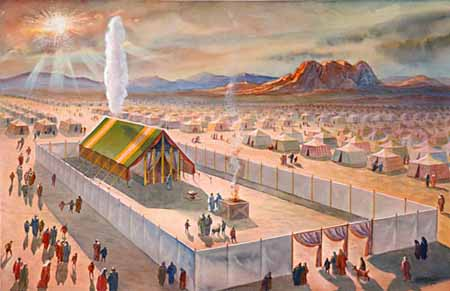
Main Theme: The sanctuary demonstrated God’s closeness to humanity and revealed the greatest truths to them, which is how He saves those who come to Him in faith.
Study: What truth was reiterated to the people here in the context of the building of the sanctuary?
Apply: The Jews have a saying: More than Israel kept the Sabbath, the Sabbath kept Israel. Though we as Adventists probably wouldn’t express it like that, what important role does the Sabbath have in the life of our church family?
Share: Your friend asks you if warming up food on an electric stove, or even turning a light switch on, counts as starting a fire on the Sabbath. What is the principle behind the law not to build a fire on the Sabbath? Are we still keeping the principle of the law when we turn on a stove or a light?
Study: What important lessons are here for us today?
Apply: What spiritual gifts have you received when you were filled with the Holy Spirit? Remember that the spiritual gifts can flourish only when you cultivate the fruits of the Spirit in your life (Gal. 5:22-23).
Share: Your friend asks how she can know what her spiritual gifts are. What do you tell your friend?
Read in Class: Exodus 40:34-38. Ask the class to share the main idea of this passage.
Study: How did the Israelites discern God’s presence?
Apply: What are ways that, even now, you can experience the presence of God? Why is it important that you do so?
Share: Your friend says that sometimes she feels God is with her, but other times she does not. She asks how to know if God is with her or not. Is it safe to just go by our feelings? How would you answer your friend from the Bible?
Read in Class:John 1:14. Ask the class to share the main idea of this passage.
Study: How is Christ’s incarnation compared to the tabernacle?
Apply: Read in Revelation 21:1-3. Looking at what we have been promised in Jesus, how can we learn to endure to the end?
Share: What new truths and insights did you gain as you studied this quarter’s lesson?
Main Theme: This week, we study how Moses, through knowing and following God’s instructions, was growing in his walk with the Lord.
Read in Class:Exodus 33:12-17. Ask the class to share the main idea of this passage.
Study: What did Moses ask the Lord to teach him? Why did he demand God’s presence to guide them?
Apply: Do you know God, or do you just know about Him? What is the crucial difference between the two?
Share: Your friend says that Romans 2:4 tells us the goodness of God leads us to repentance. Your friend asks how God revealed His goodness in the book of Exodus. What do you tell your friend?
Read in Class:Exodus 33:18-23. Ask the class to share the main idea of this passage.
Study: How did God answer Moses’ request to see His glory?
Apply: How much time do you spend focusing on the Cross and what it tells you about the character of God?
Share: Your friend asks, How does your church reflect the glory of God to others. What do you tell your friend?
Read in Class:Exodus 34:6-9. Ask the class to identify the main idea of this passage.
Study: How did God reveal His glory to Moses?
Apply: How can we preach a merciful and forgiving God without it being confused with what is referred to as “cheap grace?”
Share: Your friend says that to reflect the proper balance of God’s holiness and compassion, we should be conservative towards ourselves and liberal towards others. Do you agree with your friend? Was Jesus conservative towards Himself while being liberal towards others? What do you tell your friend?
Read in Class: Exodus 34:29-35. Ask the class to share the main idea of this passage.
Study: What was the cause of Moses’ radiant face?
Apply: What areas of your character need to reflect the character of God better? Probably every area, right? However, how can focusing on the Cross, and what it means, give you encouragement and assurance of salvation?
Share: Tell about someone who reflected God’s glory to you like Moses did to Israel.
Where there is no counsel, the people fall; But in the multitude of counselors, there is safety. Proverbs 11:14 NKJV
As iron sharpens iron, so a man sharpens the countenance of his friend. Proverbs 27:17 NKJV
As we study this week’s Sabbath School lesson, about the apostasy of Israel, including Aaron, their priest, I am reminded of a vital lesson. We cannot assume a pastor or any church leader is doing a good job just because they are making everyone happy. After all, the greater majority of the people were delighted with Aaron while he was leading them into apostasy. The point was made that Aaron should not have allowed the people to worship an idol, much less help them make one. With the majority being in the wrong, Aaron should have stood for the right, even if all alone.
The greatest want of the world is the want of men—men who will not be bought or sold, men who in their inmost souls are true and honest, men who do not fear to call sin by its right name, men whose conscience is as true to duty as the needle to the pole, men who will stand for the right though the heavens fall. –Ellen White, Education, Page 57.
Being a pastor, I also see the problem from another angle. While the pastor may chair the church board, the pastor answers to the church board, and the church board answers ultimately to the church at large. In other words, while the pastor holds the church accountable, the church also holds the pastor accountable. Accountability works both ways.
So, as we study the apostasy of Israel when they made and worshiped the golden calf, we see a total breakdown of accountability. Not only was Aaron not holding the people accountable, but the people were not holding Aaron accountable. The problem was that no one was holding anyone accountable. Here is where we see how crucial accountability is to both laity and leaders.
The other day, I was having a conversation with a young couple, when the husband said something so profound that I had never heard a husband say before. He said one of the reasons he wanted to find someone to marry was that he needed someone to be accountable to. In a world where everyone is told to mind their own business, not to judge or criticize, and to let others do as they please, this young man realized he could not be all that God expects him to be without offering accountability. Having someone to be accountable to helps to keep us out of trouble and focused on our lofty goals.
In order for a church to stay out of trouble and focused on their lofty goals they need leaders who will hold them accountable. At the same time in order for church leaders to stay out of trouble and focused on their lofty goals they need a church body that will hold them accountable. While the pastor may advise the board, the pastor should also consider the board members as his advisors as well. The pastor should not consider it a weakness or be embarrassed to seek counsel from his church family. On the contrary the wisdom in Proverbs tells us we are all here to sharpen each other, and there is wisdom in having many counselors.
There was a time when I was embarrassed to ask the church for guidance, not because of my ego, but because I felt like I was being paid to know what was right, and if I was not right or did not know what was right then I was not earning my paycheck. Later I realized my job is not so much to always be right or know on my own what is right, as much as it is to find what is right. We actually gain the confidence of our church family when we quickly discern our mistakes and make corrections. Meanwhile I have watched other pastors shipwreck their own ministry by pretending to be infalible instead of accepting the counsel, mercy and forgiveness their congregations so willingly offered. It broke my heart recently, when some friends told me about a pastor in their church who made a mistake, and instead of accepting their forgiveness and invitation for reconciliation, he resigned claiming to be above reproach.
For marriage to work, both the wife and the husband need to offer accountability to each other. In the church, not only does the congregation need to provide accountability to the pastor, but the pastor also needs to offer accountability to his congregation. Aaron and Israel’s apostasy with the golden calf is an unfortunate example of what happens when neither congregation nor pastor holds the other accountable. While Aaron should have stopped the people from committing apostasy, the people should have stopped Aaron from committing apostasy. Accountability works both ways.
You may study this week’s Sabbath School lesson here.






 In Light of The Cross