8: In the Psalms, Part 1-Sabbath School Lesson Teaching Plan

Prepared by William Earnhardt, for Sabbath School class, May 24, 2025.

Main Theme: Some details provided in God’s songbook can give us new ways to understand and appreciate our role in the final moments of Earth’s history.

Read in Class: Hebrews 9:11-15. Ask the class to identify the main idea in this passage.

Study: What does this teach about what He is doing for us?

Apply: Read Psalm 122. Though we cannot go literally to the earthly “house of the LORD” (it’s not there, and even if one were built in the same place, it would be meaningless), what elements are found in this Psalm that can encourage us about what Christ has done for us? Notice the themes of peace, security, praise, and judgment.

Share: Your friend asks why Jesus is in the sanctuary. Wasn’t everything finished at the cross? What do you tell your friend?

Read in Class: Exodus 33:18-23, Exodus 34:1-7, and Psalm 119:55. Ask the class to identify the common thread in these passages.

Study: When Moses asked to see God’s glory, what did God promise to show him? Then, when God proclaimed His name to Moses (Exod. 34:5), what followed?

Apply:  How does following the law help us become more merciful and sympathetic towards the needs of others, especially those who may have special needs we do not have?

Share: Your friend says, “If we are saved by faith and not by the law, what is the importance of God’s law?” What do you tell your friend? (See 1 John 5:3.)

Read in Class: Psalm 5;1-12, and Revelation 14:1-12. Ask the class to identify the main idea of these passages.

Study: What similarities do you find in these two passages, and how does this inform your understanding of what it means to be a part of God’s last-day remnant movement?

Apply: Imagine standing before a holy and perfect God in judgment, with every deed you have ever done fully exposed before Him. What does this prospect tell you about your need for Christ’s righteousness?

Share: Your friend asks, “Why do the saints have the faith of Jesus and keep the commandments? I thought we are saved by faith, not commantment keeping.” What do you tell your friend?

Read in Class: Psalm 51:7-15. Ask the class to share the main idea of this passage.

Study: What does David promise to do after he has been pardoned and purged from his sin?

Apply: Dwell more on the fact that, even before the proclamation of the three angels’ messages begins, we are pointed to the “everlasting gospel.” What should this tell us about how foundational this truth is to all that we believe?

Share: Your friend says, “I hear Christians always talking about the Gospel. What exactly is the Gospel?” What do you tell your friend?

5: The Nations Part 2-Sabbath School Lesson Teaching Plan

Prepared by William Earnhardt, for Sabbath School class, May 3, 2025.

Main Theme: This week, we will continue looking at the problems caused by the Fall and the desire for human government as opposed to God’s governance. These truths are powerfully revealed in the book of Daniel, which shows that God was right when He warned His people about what would happen when they turned away from Him and chose earthly monarchs instead. This is exactly what they got: earthly monarchs instead, and sinners lording it over sinners—never a good combination.

Read in Class: Genesis 2:9-17. Ask the class to share the main idea of this passage.

Study: What was the first command, a prohibition, that God gave to humanity, and why was it so important?

Apply: Think about the kinds of knowledge, even now, that many of us would be better off not knowing. How does this help us understand what was forbidden in Eden?

Share: Your friend says she was reading in Christ Triumphant that the serpent was also insinuating that Eve would know for herself what was good and evil. In other words, God would not be telling her what was right and wrong, but she would be like God and be able to decide for herself what was right and wrong. Your friend asks, what kind of impact does it have on our church and nation when we decide for ourselves what is right and wrong instead of letting the Bible tell us right and wrong?

Read in Class: Daniel 2:31-35. Ask the class to share the main idea of this passage.

Study: What important truths can we learn from this amazing prophecy?

Apply: Jesus warned, “ ‘And you will hear of wars and rumors of wars. . . . For nation will rise against nation, and kingdom against kingdom. And there will be famines, pestilences, and earthquakes in various places’ ” (Matt. 24:6-7, NKJV). Despite these warnings, how can we draw comfort from knowing that we have been warned beforehand about them?

Share: Your friend asks you how we know Jesus is coming. What prophecies that have already been fulfilled can you share that will help your friend trust future prophecies about Jesus’ soon coming?

Read in Class: Daniel 7:1-3. Ask the class to share the main idea of this passage.

Study:  There is a lot of movement in this scene. What lessons can we draw from this imagery, such as the beast first arising from the sea?

Apply: How does Romans 3:10-19 help explain so much of our world? How does verse 19, especially, show why we so desperately need the gospel in our lives?

Share: Your friend asks why the Adventist Church isn’t more involved in politics, especially trying to legislate morality. What do you tell your friend?

Read in Class: Revelation 10:1-11. Ask the class to share the main idea of this passage.

Study: Look for some of the elements we have studied, such as “the nations,” the land, and the sea. Applying appropriate caution, so that you do not read too much into the passage, what potential insights can you find in this account?

Apply: Look at how accurately the prophecies of Daniel 2 and Daniel 7 predicted the rise and fall of all these worldly empires. Why should that accuracy, amazing if you think about when Daniel was written, help us trust Him on the promise of the final and eternal kingdom—God’s?

Share: In the end, all earthly accomplishments, no matter how grand, no matter how great, no matter how awe-inspiring and glorious, will be turned to dust, to ashes, and ultimately vanquished forever. That includes whatever great and glorious earthly things you might have accomplished or are accomplishing now. Why is it always important to keep this perspective in mind? How should this perspective help you keep your priorities straight as we share and interact with others?

Called out of a Babylonian Way of Thinking Into a Christ-Centered Way of Thinking

Several years ago, I read Cowan and Kuenster’s compelling yet depressing book To Sleep With the Angels: The Story of a Fire. It was about a horrific fire where a Catholic school burned, and 92 students and three teachers perished. The book investigated all the things that went wrong that day. For example, the Mother Superior was substituting in the Kindergarten room, unaware that the rest of the school was on fire. The problem was that only Mother Superior could call for an evacuation, so several teachers kept their students in their smoke-filled rooms waiting for Mother Superior’s permission to evacuate. Finally, after it was too late, the teachers decided to go ahead and evacuate even though they did not have her permission. 

As I read this book, I could not help but be amazed at a hierarchy system that would not allow the students and teachers to think and act for themselves, causing them to lose their lives! I thought that many in that type of hierarchical system will burn in the lake of fire simply because they trusted in the hierarchy instead of studying the Bible for themselves. 

The doctrine that God has committed to the church the right to control the conscience, and to define and punish heresy, is one of the most deeply rooted of papal errors.-Ellen White, The Great Controversy, Page 293

While reading about a Catholic School, I realized many wonderful Catholics are reading their Bibles and finding Bible truth. I recognize also that while spiritual Babylon is a specific system, it is also an attitude. It’s the attitude of those at the tower of Babel and later in Daniel 4. It is the Babylonian king who thought he was saved by his mighty power, when he said, “Is not this great Babylon, that I have built for a royal dwelling by my mighty power and the honor of my majesty?” Daniel 4:30 NKJV So I see all down through the ages, Babylon is an attitude, and that attitude can be found anywhere, including our hearts. So the call out of Babylon is more than just a call out of a papal system. It is a call out of a hierarchy-based mindset. That mindset goes back way before the papacy. It was in the church of Christ’s day, and that is why He had to call His disciples out of that mindset when He told them, 

“You know that the rulers of the Gentiles lord it over them, and those who are great exercise authority over them.  Yet it shall not be so among you; but whoever desires to become great among you, let him be your servant.  And whoever desires to be first among you, let him be your slave—  just as the Son of Man did not come to be served, but to serve, and to give His life a ransom for many.” Matthew 20:25-28 NKJV

This tells me the call out of Babylon in Revelation 18 may involve more than just a few doctrines on the Sabbath and the state of the Dead. I may be called out of a legalistic or authoritarian Babylonian mindset into a whole new way of thinking. 

After these things, I saw another angel coming down from heaven, having great authority, and the earth was illuminated with his glory. And he cried mightily with a loud voice, saying, “Babylon the great is fallen, is fallen, and has become a dwelling place of demons, a prison for every foul spirit, and a cage for every unclean and hated bird! For all the nations have drunk of the wine of the wrath of her fornication, the kings of the earth have committed fornication with her, and the merchants of the earth have become rich through the abundance of her luxury.” Revelation 18:1-4 NKJV

The call out of Babylon is a call out of a false system of worship. This false worship is more than a false day of worship. It also worships a false god called “legalism,” better known as “our works.” It is also a calling out of a false hierarchical system that is based on humans assuming the prerogative of God to compel the conscience of those  “under them” to act and worship a certain way. And it is a calling out of complying with the direction of people in positions of power to do things that are against the principles of the Bible, which asks us to worship God alone, and allow Him to guide our conscience instead of man.

We are not just called out of false churches. No matter what church we attend, we need to come out of a false way of thinking into a new mindset. We are called out of the hierarchical system of not only the papal mindset but also the mindset of the Babylonians and the religious leaders in Christ’s day. We are called out of the mindset of becoming dictators into the mentality of servants serving God and others the way Christ served His Father and others. And we are called out of placing man in the place of God Himself. 

You may study this week’s Sabbath School Lesson here.

2: The Genesis Foundation-Sabbath School Lesson Teaching Plan

Photo by Ovais Ibn farooq on Pexels.com

Prepared by William Earnhardt for Sabbath School Class, April 12, 2025.

Main Theme: This week, we are going to study a handful of big concepts at the core of Revelation. There are many, and so we will choose a few to illustrate the all-important point that understanding the ancient foundations behind Revelation enables the student to see countless nuances in the text, each of which can yield important lessons about the nature of humanity, of God, and of the conflict being waged in our universe and, thus, in our lives, as well.

Read in Class: Genesis 22:1-13. Ask the class to summarize this passage in their own words.

Study: The first mention of “love” in the Bible is found in Genesis 22:2. What does this story teach us about the nature of God’s love?

Apply: Read John 3:16. What parallels apply between the story of Abraham in Genesis 22 and the love of God in John 3:16 and the cross? What are the similarities, and what are the differences?

Share: Your friend says she has heard that God tested Abraham so he could prove his obedience. Others say the story of Abraham and Isaac was only an illustration of God’s self-sacrificing love for us. She asks what you think. What do you tell your friend?

Read in Class: Genesis 22:7-8, Exodus 12:3-13 and Revelation 5:5-10. Ask the class to identify the common thread in these passages.

Study: How does the story of Isaac’s near-sacrifice help us understand how lambs are used symbolically? How does this story tie into what John sees in Revelation 5?

Apply: Why is knowing that Jesus is our Substitute so foundational to our salvation? What hope would you have without Him, as that Substitute, especially in the judgment?

Share: Your friend asks why God wanted the people to have the lamb in their home four days before sacrificing it? What do you tell your friend?

Read in Class: Genesis 2:15-17, Genesis 4:8-15, 1 Corinthians 15:15-19, and Revelation 1:18. Ask the class to identify the common thread in these passages.

Study: What do these passages—which include the first mention and occurrence of death—tell us about why people die, how God views death, and what His solution is for our problem?

Apply: Without the problem of death being solved, why are our lives ultimately useless, meaningless and futile? What does this fact teach us about how thankful we should be for what Jesus has done for us?

Share: Romans 6:23 tells us the wages of sin is death. Wages are something we have earned. However the gift of God is eternal life. A gift is something we have not earned. Your friend asks how do we get the gift of eternal life? What do you tell your friend? Hint: See Salvation in Light of the Cross.

Read in Class: Genesis 3:1-5 and Revelation 12:1-9. Ask the class to identify the common thread in these passages.

Study: What are some of the common themes in each account? How do the details found in the introduction of the serpent in Genesis help us to understand some of the issues that had previously led to the war in heaven mentioned in Revelation?

Apply: Read in Numbers 21:4-9 and John 3:13-17. How did Jesus apply the story of the brass serpent, as the solution for when we are bitten by the serpent and deceived into sin?

Share: Can you think of someone you can share the plan of salvation with this week?

What is Wrong With the Futuristic View of Revelation?

Protestant reformers like Martin Luther used a system of prophetic interpretation based on fulfilled prophecies of the past. They found the keys to prophecies for the future in fulfilled prophecies of the past. They saw, for instance, how prophecies had been given in days and fulfilled in years. They saw names and animals that had been used for certain world powers, and they saw these same names and some of the same animals used in prophecies for the future. When Martin Luther used this system to interpret the prophecies of Revelation, he concluded that the system of the papacy was the antichrist in the book of Revelation.

Now keep in mind that it was never Martin Luther’s intention to start a new church. He wanted to reform the Catholic church. He was trying to work within the church to bring it back to the Bible, but when the church refused to go back to the Bible, Luther had to move forward.

John Hus, John Knox and many more Protestant reformers preached that the Pope was the antichrist, and that interpretation was carried on by the churches they founded. The 1260 day-for-a-year prophecy has demonstrated their calculations to be correct. Yet today, while we understand that God has His people in every church, including the Catholic church, 1many are afraid to identify the antichrist in Revelation as the papal system. Because of this, a new way of studying Bible prophecy was devised, 2which is what we now know as the futuristic approach in place of the previous historicist approach used by the Reformers and earlier Christians. It played an important role in the  Counter Reformation. This places all of the events in Revelation in the future so as not to identify the papacy as the antichrist. However, this theory has several flaws.

For instance, in January 1991, the United States began Desert Storm to relieve Kuwait from Iraqi oppression. U.S. helicopters and other aircraft were swarming the desert. At the time, a popular theologian in the futuristic tradition suggested that Revelation 9:3 was being fulfilled since the locusts mentioned in this passage were symbolic of the helicopters swarming the desert.

The problem with that interpretation is that Revelation 9 has already been precisely fulfilled, using the day-for-a-year principle concerning 391 years and 15 days, ending on exactly August 11, 1840, when the Ottoman Empire accepted guarantees and declared its dependence upon surrounding nations to survive. 3When this prophecy was fulfilled right down to the exact day of August 11, 1840, many people who had scoffed at the Bible became Bible-believing Christians. 

Today most popular Protestant churches have rejected the historicist method of interpreting prophecy, as it is no longer politically correct to identify the antichrist biblically. They have joined the Catholic church’s interpretation of prophecy in Revelation to put everything in the future, thus nullifying much of what was accomplished and gained in the Reformation. 

Here are some problems that exist now with the futuristic view of prophecy.

With the futuristic approach to Revelation, there is no way to determine the probable accuracy of an interpretation because there are no checks and balances, such as the day-for-a-year principle, to test predictions. For example, Desert Storm does not fit the time period for Revelation 9.  However,  interpretations using the day-for-a-year principle fall into place with other prophecies in Daniel and Revelation. With the futuristic approach, there is no rhyme or reason to interpretations, and many predictions are only proven wrong once they don’t come to pass. That’s why some have called The Revelation “the happy hunting ground of fraudsters and religious fanatics.” 

The futuristic view denies all prophecies that have already been accurately fulfilled using the day-year principle by putting them in the future. This means nullifying much of the evidence that the Bible is true. This destroys not only the credibility of prophecies but of the Bible itself. 

While recognizing that God has His people in all churches, and that every church has sincere worshipers who will make up the kingdom of heaven, we should not be afraid to teach accurate prophetic interpretations, even though they may not be currently “politically correct.”

By using the historical day-for-year principle in studying the prophecies of Revelation, we prove the Bible to be true and trusted by what has already been accurately fullfifilled, and we can properly warn all of God’s people in all of us churches of the false teachers and their doctrines which lead men away from Jesus, as our only True Teacher. 

Do you have any experience to share about the day-for-a-year principle compared to the futuristic view?


References

  1. I believe there will be more Catholics in heaven than in any other church. 
  2. Look up Francisco Ribera (1537–1591), the originator of the futuristic approach to prophecy. 
  3. You can see a facsimile copy of Josiah Litch’s original article in the Signs of the Times of Aug. 1, 1840 

You may study this week’s Sabbath School lesson here.

1: Some Principles of Prophecy-Sabbath School Lesson Teaching Plan

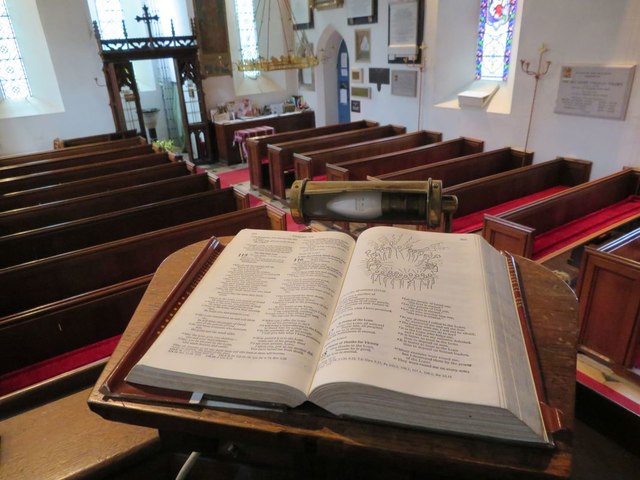
Bible on the pulpit by Bill Nicholls is licensed under CC-BY-SA 2.0

Prepared by William Earnhardt for Sabbath School Class, April 5, 2025.

Main Theme: This week, we will explore some principles that yield a consistent and reliable understanding of prophecy.

Read in Class: Matthew 24:15, Revelation 1:3 Matthew 11:29 and Jeremiah 9:23-24. Ask the class if they see any common threads in these passages.

Study: What do these texts suggest about God’s intention to make Himself understood?

Apply: What are some technigues you have found helpful in understanding the Word of God?

Share: Your friend says she enjoys trying to find “loopholes” in the Word of God. Why may that not be a good idea. What do you tell your friend?

Read in Class: Psalm 139:1-6, Psalm 147:5, Romans 11:33 and 1 John 3:20. Ask the class if they see any common threads in these passages.

Study: What do these passages suggest about God’s understanding in comparison to our own?

Apply: Though, yes, there is much that we don’t know, why is it crucial to focus now on what we do know and to follow what we know—as opposed to obsessing over what we don’t know?

Share: Your friend says his pastor said we should not worry about things we read in the Bible that are not salvation issues. Your friend asks what is meant by salvation issues? What do you tell your friend?

Read in Class: Matthew 5:18, 2 Timothy 3:15-17, and Luke 24:27. Ask the class if they see any common threads in these passages.

Study: What do these verses teach us about the way we ought to approach Bible prophecy?

Apply: What has been your experience with those who use only certain selected texts to try and make their point about, say, the state of the dead? Or even the Sabbath? What is the best way to respond?

Share: Your friend asks if Seventh-day Adventists have any traditions, good or bad, that cannot necesarrily be supported by Scripture? What do you tell your friend?

Read in Class: Daniel 7:7, Daniel 7:24, Revelation 1:16, and Revelation 1:20. Ask the class what common threads they see in these passages.

Study: How does Daniel 7:24 help us understand Daniel 7:7 and how does Revelation 1:20 help us understand Revelation 1:16? Does this show us that the Bible inteprets itself for us?

Apply: Even if some symbols and prophecies remain mysteries, how can focusing on what we do understand strengthen our faith?

Share: Your friend asks why God speaks in symbols instead of just being more literal or forthright? What do you tell your friend?