Tag / Bible worker
Video: Christmas in Light of the Cross Day 4; as far as the Curse is Found
Video: Christmas in Light of the Cross day 3
Video: Christmas in Light of the Cross Day 2. Promises you can Believe
Video: Christmas in Light of the Cross Day 1. Plenty of Room in My Father’s House
Stacy and Charlie’s Baptism Pictures and stories
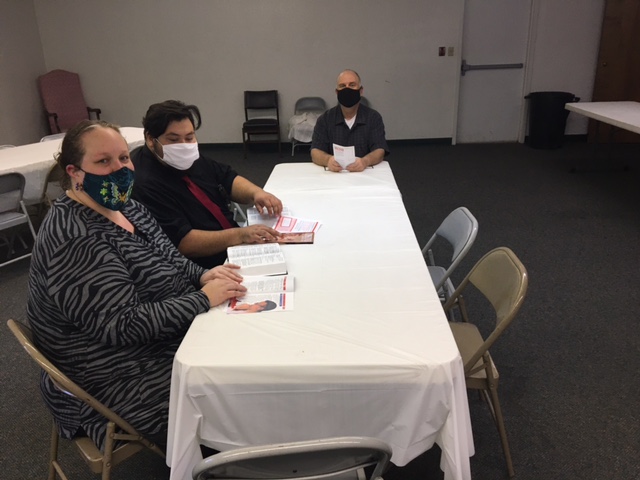
I first met Charlie about 5 years ago in the youth Bible studies at the Plant City Seventh-day Adventist Church on Wednesday nights. Several of the youth from the community would come to play games and have a Bible study. So I was very happy when Charlie’s girlfriend, Stacy contacted me for baptism studies! We were able to study at the church while practicing social distancing as well as over the phone.

Charlie’s grandmother was a big part of the Plant City SDA Church back in the day. She even designed the picture on our baptistry. She now lives in Ooltewah Tennessee. This morning, November 28, 2020 Charlie and Stacy surprised his grandmother by being baptized in the Ooltewah SDA Chruch! A very big thank you to Pastor Peter Kulakov (Right) for being such a gracious host for this baptism!

Charlie and Stacy with their “Just baptized” masks.
What and exciting day for the Plant City SDA Church, the Ooltewah SDA Church and all of heaven! If you are interested in giving your life to Jesus because of His great love and sacrifice that He made for you I would love to talk with you! You can contact me at racerthee@gmail.com.
I also want to thank all of my contributors to my ministry that keep these wonderful baptisms coming! Click here to find out how you can be a contributor. Thank you!
Jesus Taught Dignity and Compassion

And Jesus said to her, “Neither do I condemn you; go and sin no more.” John 8:11 NKJV
For years the church has loved pointing out that while Jesus forgave the woman trapped in adultery, He also told her to “sin no more.” And for years Seventh-day Adventists have been overlooking one of the greatest lessons Jesus ever taught. Jesus did not tell the woman to go and sin no more and then He would not condemn her. He told her He would not condemn her. More than freeing her from the condemnation of the law, Jesus was freeing the sex-slave who was callously thrown at his feet from her own self condemnation. He was restoring her dignity and sense of self worth so she was was now free to live the better life that she so desperately longed for but had only dreamed about.
They told her they loved her. Said she was beautiful. Promised her she would be special. Next thing she knew she was being dragged out of bed by the very ones who dragged her into bed, and those who had praised and flattered her just stood and watched her being dragged away, as their trap and plan unfolded.
Now she was kneeling half naked, humiliated before Jesus. Eyes closed, not wanting to see the stones that would soon be crushing her head, she waited in terror. It seemed like eternity. When would it be over?
Barely peeking through one eye she sees Jesus doing something in the sand. Not sure what. She hears footsteps as men walk away. What is going on? Then she hears a word she had not heard in years directed at her.
“Woman…”
Jesus didn’t call her a “slut,” or “whore.” He called her “woman.” He was addressing her with the same title of respect that He gave to his own mother, who spoke with angels and gave birth to the Son of God.
“….where are those accusers of yours? Has no one condemned you?” John 8:10 NKJV
She opens her eyes and looks around. They are all gone! She makes no accusations against the men. We know little about the background of this woman. She may or may not have been a victim of sex trafficking. But we do know that, terrified as she was, she was ready to face the consequences without blaming anyone else for the choices she had made, and the role she had played, which now brought her half-naked and humiliated into the presence of Jesus. Yet incredibly, as guilty as she was, it was her accusers who slunk away. As she lay helpless at His feet, there was no one to condemn her! When we fall helplessly at the feet of Jesus, there is no condemnation for us either.
He said to her, “Woman, where are those accusers of yours? Has no one condemned you?” (John 8:10 NKJV)
She said, “No one, Lord.” (John 8:11 NKJV)
What was next? A sermon? A lecture? Nowhere is it recorded, but I can imagine Jesus placing His coat over her near-naked body.
The Holy One Who would be hanging naked on a cross in front of the entire universe one day, takes off His robe and covers this woman, protecting her human dignity more than just covering her sexuality.
He doesn’t preach to her. He ministers to her.
Did you know you don’t have to be a preacher to be a minister? Ministering to sinners doesn’t always have to include a sermon. An-ill timed sermon can do more harm than good. Jesus could preach with the best of them, but He knew when to preach and when not to preach. He also knew when to minister.
He called her “woman.” He placed His coat over her near-naked body and gave her the sense of dignity she had been promised by the man who betrayed her trust. Then He did not preach to her with words, He ministered to her with words.
“Neither do I condemn you; go and sin no more.” John 8:11 NKJV
His words were brief and clear, yet somehow we get them mixed up. Have we ever told someone “Go and sin no more, and then I will stop condemning you!” Have you ever told a young man or woman, “we treat you like a child because you act like a child? Stop acting that way and then we will stop treating you that way.” That’s not what Jesus said. Jesus restored her dignity instead of asking her to act more dignified.
Jesus said clearly, “Neither do I condemn you.” Present tense.
“Go and sin no more.” Future tense.
The world told her they would stop condemning her once she stopped sinning. Jesus promised not to condemn her, so she could stop sinning.
They called her a whore and a slut.
Jesus called her a woman.
Mankind promised her she would be special, and then humiliated and betrayed her.
Jesus restored her dignity and made her special.
There was no condemnation for this woman at the feet of Jesus, and there is no condemnation for you, when you kneel at the feet of Jesus. By the way I love how Jesus turned a dirty trick into something beautiful. No matter how ill intended their evil plot was, these wicked men still brought a woman to the feet of Jesus where she found salvation! Their plan backfired! Grace has a way of defeating every intention of Satan. By the way to this day we still do not know exactly what Jesus wrote in the sand that day. That message was for those evil men alone. He wrote in the sand so he could reach their hearts without anyone else being able to see. Jesus will leave no means undone in His attempt to save, but public humiliation is the last thing Jesus wants to do if there is any way around it. That is one reason why Jesus says in Matthew 18 to go to the offender privately so hopefully it can be resolved without anyone else hearing of the matter. Still Jesus loves the sinner so much if not resolved it may have to be brought before the entire church and public humiliation may have to be encountered so salvation can become a reality. Yet Jesus wants to protect human dignity. After all He worked His first miracle of turning water into wine just to save a host from public embarrassment. He wrote in the sand to save sinners from public embarrassment, while also protecting the dignity of the woman. Picture of Jesus show a towel around His waist as He hung on the cross. Reality check, there was no towel around his waist in real life. Jesus hung naked in front of the entire universe taking on all of the public humiliation the universe deserves so He could save the universe from all of the public humiliation the entire universe deserves. Let that sink in. Ellen White in Desire of Ages, page 25 tells us Jesus was treated as we deserve so we can be treated as he deserves.
Jesus, the Master teacher did not embarrass His students. He dignified them. He did not tell them to stop making mistakes so He could stop condemning them. He stopped condemning them so they could be free from making the same mistakes again.
You may study this week’s Sabbath School lesson here.
Written Transcript With Video Presentation: The 7 A’s of Confession and Reconciliation
Wednesday’s section of this week’s lesson reminded me about the importance of reconciliation. Reconciliation is so important to God that from Genesis 3 to Revelation 20, the theme of reconciliation.
Like King David in 2 Samuel 12:1-12, we all get mad when we hear about oppression and injustice. Like King David, most of us have been guilty of oppression and injustice at some point. When we find ourselves guilty, it is important to make confession and reconciliation, not just to get rid of our guilt and heal our conscience, but to heal the pain of those we have hurt. In Ken Sande’s book, Resolving Everyday Conflict, he shares the 7 A’s of confession and reconciliation. I would like to take a further look at them here, along with God’s Word. In so doing, I believe we can find a genuine and successful approach to healing the pain we have caused others. Please keep in mind that not all the steps need to be followed for lesser offenses. You will need to pray and let God lead you as to exactly what steps to follow.
Keep in mind also that after Adam’s sin, the Garden of Eden was no longer a safe place for him. While God forgave Adam, he was never permitted back into the Garden here on earth. What a thrilling moment it will be, when in the New Earth, Adam is reconciled to God and Adam’s Eden home is restored! Likewise there are some extreme cases of oppression and abuse, where certain relationships will only be safely reconciled and restored in the New Earth. Meanwhile what a precious blessing and responsibility it is to restore and reconcile what can be reconciled here on earth.
The 7 A’s of Confession and Reconciliation.
- Address Everyone Involved.
Sins committed only in the heart need to be confessed to God alone. Public sins need to be confessed to all those who were hurt.
Confess your sins to each other and pray for each other so that you may be healed. James 5:16 NLT
2. Avoid Using the words, “if” “but” and “maybe.”
Say “I hurt you.” Not, “If I hurt you.” Say “I was wrong.” Not, “I was wrong but so were you.” Say, “I know I made a mistake.” Not “Maybe I made a mistake.” Don’t shift, minimize or excuse your guilt.
People who conceal their sins will not prosper, but if they confess and turn from them, they will receive mercy. Proverbs 28:13 NLT
3. Admit Specifically Where you were wrong.
Don’t be vague.
Forgive me for shedding blood…Psalm 51:14 NLT
4. Acknowledge the Hurt.
You can even ask, “Do I understand how much I’ve hurt you?”
When Saul sinned, the throne was taken from him, because he was only sorry about what his sin had cost him personally. David sinned an even greater sin, but kept the throne, because He was truly sorry about what his sin had cost God.
Against you, and you alone, have I sinned; Psalm 51:4 NLT
5. Accept the Consequences.
Genuine repentance accepts any due penalties.
Zacchaeus stood before the Lord and said, “I will give half my wealth to the poor, Lord, and if I have cheated people on their taxes, I will give them back four times as much!” Luke 19:8 NLT
6. Alter Your Behavior.
You are not really sorry if you keep willfully repeating the same offense. Ask people to hold you accountable. You may even put your plan for change into writing. One of the reasons I am writing about this topic is to reinforce it in my own mind.
If you are a thief, quit stealing. Instead, use your hands for good hard work, and then give generously to others in need. Ephesians 4:28 NLT
7. Ask for Forgiveness (and allow time)
If it took you a while to confess, it may take a while for the other person to forgive. Don’t push it or rush it. If you are sincere and genuine in these 7 steps, most people will be quick to forgive.
Often when we try to place the blame on others, they will turn around and place the blame on us. On the other hand, when we accept full responsibility for our actions, others will often accept responsibility for their actions.
I have attempted to simplify and paraphrase the ideas in Ken Sande’s book, to reinforce them for myself and to help others to make reconciliation. When we find ourselves being oppressed or treated unjustly it is easy to just run away or attack back. When mankind rebelled against God, God neither ran away or attacked back. Instead He presented Himself as the peace offering for our offense! Genesis 3 to Revelation 20 deals mainly with God’s attempt at reconciliation. This tells me reconciliation is very important.
It may seem hard to make confession and reconciliation. It may seem easier to run away. It may cost us our pride to make reconciliation, but that is a small price considering it cost God His dear Son. If reconciliation is worth God’s Son, then it is definitely worth anything it would cost us.
7 A’s of Reconciliation

Wednesday’s section of this week’s lesson reminded me about the importance of reconciliation. Reconciliation is so important to God that from Genesis 3 to Revelation 20, the theme of reconciliation.
Like King David in 2 Samuel 12:1-12, we all get mad when we hear about oppression and injustice. Like King David, most of us have been guilty of oppression and injustice at some point. When we find ourselves guilty, it is important to make confession and reconciliation, not just to get rid of our guilt and heal our conscience, but to heal the pain of those we have hurt. In Ken Sande’s book, Resolving Everyday Conflict, he shares the 7 A’s of confession and reconciliation. I would like to take a further look at them here, along with God’s Word. In so doing, I believe we can find a genuine and successful approach to healing the pain we have caused others. Please keep in mind that not all the steps need to be followed for lesser offenses. You will need to pray and let God lead you as to exactly what steps to follow.
Image © Lars Justinen Goodsalt.com
Keep in mind also that after Adam’s sin, the Garden of Eden was no longer a safe place for him. While God forgave Adam, he was never permitted back into the Garden here on earth. What a thrilling moment it will be, when in the New Earth, Adam is reconciled to God and Adam’s Eden home is restored! Likewise there are some extreme cases of oppression and abuse, where certain relationships will only be safely reconciled and restored in the New Earth. Meanwhile what a precious blessing and responsibility it is to restore and reconcile what can be reconciled here on earth.
The 7 A’s of Confession and Reconciliation.
- Address Everyone Involved.
Sins committed only in the heart need to be confessed to God alone. Public sins need to be confessed to all those who were hurt.
Confess your sins to each other and pray for each other so that you may be healed. James 5:16 NLT
2. Avoid Using the words, “if” “but” and “maybe.”
Say “I hurt you.” Not, “If I hurt you.” Say “I was wrong.” Not, “I was wrong but so were you.” Say, “I know I made a mistake.” Not “Maybe I made a mistake.” Don’t shift, minimize or excuse your guilt.
People who conceal their sins will not prosper, but if they confess and turn from them, they will receive mercy. Proverbs 28:13 NLT
3. Admit Specifically Where you were wrong.
Don’t be vague.
Forgive me for shedding blood…Psalm 51:14 NLT
4. Acknowledge the Hurt.
You can even ask, “Do I understand how much I’ve hurt you?”
When Saul sinned, the throne was taken from him, because he was only sorry about what his sin had cost him personally. David sinned an even greater sin, but kept the throne, because He was truly sorry about what his sin had cost God.
Against you, and you alone, have I sinned; Psalm 51:4 NLT
5. Accept the Consequences.
Genuine repentance accepts any due penalties.
Zacchaeus stood before the Lord and said, “I will give half my wealth to the poor, Lord, and if I have cheated people on their taxes, I will give them back four times as much!” Luke 19:8 NLT
6. Alter Your Behavior.
You are not really sorry if you keep willfully repeating the same offense. Ask people to hold you accountable. You may even put your plan for change into writing. One of the reasons I am writing about this topic is to reinforce it in my own mind.
If you are a thief, quit stealing. Instead, use your hands for good hard work, and then give generously to others in need. Ephesians 4:28 NLT
7. Ask for Forgiveness (and allow time)
If it took you a while to confess, it may take a while for the other person to forgive. Don’t push it or rush it. If you are sincere and genuine in these 7 steps, most people will be quick to forgive.
Often when we try to place the blame on others, they will turn around and place the blame on us. On the other hand, when we accept full responsibility for our actions, others will often accept responsibility for their actions.
I have attempted to simplify and paraphrase the ideas in Ken Sande’s book, to reinforce them for myself and to help others to make reconciliation. When we find ourselves being oppressed or treated unjustly it is easy to just run away or attack back. When mankind rebelled against God, God neither ran away or attacked back. Instead He presented Himself as the peace offering for our offense! Genesis 3 to Revelation 20 deals mainly with God’s attempt at reconciliation. This tells me reconciliation is very important.
It may seem hard to make confession and reconciliation. It may seem easier to run away. It may cost us our pride to make reconciliation, but that is a small price considering it cost God His dear Son. If reconciliation is worth God’s Son, then it is definitely worth anything it would cost us.
Which Laws Were Abolished at the Cross?

Were the ceremonial or moral laws done away with at the cross? What exactly did Christ abolish on the cross? Let’s take a look at God’s Word to see.
The ten commandments were written with God’s own hand.
So He declared to you His covenant which He commanded you to perform, the Ten Commandments; and He wrote them on two tablets of stone. Deuteronomy 4:13 NKJV
The ten commandments were placed inside the ark.
And you shall put into the ark the Testimony which I will give you. Exodus 25:16 NKJV
The commandments last forever.
The works of His hands are verity and justice;
All His precepts are sure. They stand fast forever and ever,
And are done in truth and uprightness. Psalm 111:7-8 NKJV
The ceremonial law was written in Moses’ handwriting and was placed in the side of the ark while we have seen the Ten Commandments were written by God and placed inside the ark.
So it was, when Moses had completed writing the words of this law in a book, when they were finished, that Moses commanded the Levites, who bore the ark of the covenant of the Lord, saying: Take this Book of the Law, and put it beside the ark of the covenant of the Lord your God, that it may be there as a witness against you; Deuteronomy 31:24-26 NKJV
The ceremonial laws written by Moses lasted only until the reformation.
concerned only with foods and drinks, various washings, and fleshly ordinances imposed until the time of reformation. Hebrews 9:10 NKJV
It was ordinances that were handwritten by Moses that were done away with at the cross. The ceremonial laws like the feast Sabbath days like the Passover, which pointed towards the cross no longer served a purpose after the cross. The weekly Sabbath in the ten commandments was instituted before the law was ever given (Genesis 2:1-3) and continued throughout the New Testament by Jews and Greeks alike (Acts 18:4) and will continue in the new earth. (Isaiah 66:23)
having wiped out the handwriting of requirements that was against us, which was contrary to us. And He has taken it out of the way, having nailed it to the cross. Having disarmed principalities and powers, He made a public spectacle of them, triumphing over them in it. So let no one judge you in food or in drink, or regarding a festival or a new moon or sabbaths, which are a shadow of things to come, but the substance is of Christ. Colossians 2:14-17 NKJV
Note: the requirements that were against them was the record of their rebellion we saw in Deuteronomy 31:24-26. The Ten commandments were not against them. They were there for their blessing and protection. See Psalm 19 and 119.
The sacrificial system ceased at the cross. The ten commandments never ceased.
Then he shall confirm a covenant with many for one week; But in the middle of the week He shall bring an end to sacrifice and offering.
And on the wing of abominations shall be one who makes desolate,
Even until the consummation, which is determined,
Is poured out on the desolate.” Daniel 9:27 NKJV
In the new testament commandment keeping continues.
“As the Father loved Me, I also have loved you; abide in My love. If you keep My commandments, you will abide in My love, just as I have kept My Father’s commandments and abide in His love. John 15:9-10 NKJV
He who says, “I know Him,” and does not keep His commandments, is a liar, and the truth is not in him. 1 John 2:4 NKJV
The ten commandments convict us of sin after the cross just like before.
but if you show partiality, you commit sin, and are convicted by the law as transgressors. For whoever shall keep the whole law, and yet stumble in one point, he is guilty of all. For He who said, “Do not commit adultery,” also said, “Do not murder.” Now if you do not commit adultery, but you do murder, you have become a transgressor of the law. So speak and so do as those who will be judged by the law of liberty. James 2:9-12 NKJV
Whoever commits sin also commits lawlessness, and sin is lawlessness. 1 John 3:4NKJV
Jesus did not die to do away with the law. He died so we could be obedient and live righteously.
who Himself bore our sins in His own body on the tree, that we, having died to sins, might live for righteousness—by whose stripes you were healed. 1 Peter 2:24
For the grace of God that brings salvation has appeared to all men, teaching us that, denying ungodliness and worldly lusts, we should live soberly, righteously, and godly in the present age, Titus 2:11-12 NKJV
Those who keep the commandments by God’s grace will inherit eternal life.
Blessed are those who do His commandments, that they may have the right to the tree of life, and may enter through the gates into the city. Revelation 22:14 NKJV
Summary and conclusion: The handwritten ordinances and sacrificial systems that pointed towards the cross were no longer needed after the cross. The Ten commandments were not handwritten by Moses but by God and do not point towards the cross. The ten commandments endure for all eternity.
 In Light of The Cross
