Does the Bible Teach Us to Disregard Man-Made Laws At Times?

Photo by Sora Shimazaki on Pexels.com

It is important to note that while the three Hebrews never even hinted at bowing to the image, they still attended the demonstration. They did not refuse to show up just because they knew where this was going. They obeyed the king as far as they could, until the king gave a command that directly violated God’s law. The example the three Hebrews gave us aligns with biblical counsel.

Let every soul be subject to the governing authorities….Romans 13:1 NKJV

But Peter and the other apostles answered and said: “We ought to obey God rather than men. Acts 5:29 NKJV

Paul instructs us to obey civil laws as far as possible without violating God’s law. Peter says that, of course, the law of God trumps civil law when civil law directly violates God’s law, but Peter did not teach us to violate civil law just for the sake of demanding our rights. After all, as a Christian, the only right I have is to pick up my cross and die with Christ. See Luke 9:23.

The same Peter who was thrown into prison by the civil servants, the same Peter who said we ought to obey God rather than men, also told us,

Therefore submit yourselves to every ordinance of man for the Lord’s sake, whether to the king as supreme, or to governors, as to those who are sent by him for the punishment of evildoers and for the praise of those who do good. For this is the will of God, that by doing good you may put to silence the ignorance of foolish men— as free, yet not using liberty as a cloak for vice, but as bondservants of God. Honor all people. Love the brotherhood. Fear God. Honor the king. 1 Peter 2:13-17 NKJV

Peter gave no validation for those who refuse to obey simply to defy the civil laws.

For what credit is it if, when you are beaten for your faults, you take it patiently? But when you do good and suffer, if you take it patiently, this is commendable before God. 1 Peter 2:20 NKJV

During the COVID shutdown, I was saddened by Christians who were making fun of people wearing masks and refusing to wear masks where they were required simply because they felt their rights were being taken away. Again, Luke 9:23 tells me the only right I have is to die with Christ. Wearing a mask in no way interferes with any of God’s laws. Some Christians were defiant, claiming that even more rights may be taken away that would interfere with God’s law. Still, remember the three Hebrews did not demand their rights. They obeyed just as far as they could without violating God’s law. They did not refuse to attend the ceremony just because they knew where this was going to go.

Jesus tells us,

Blessed are those who are persecuted for righteousness’ sake,
For theirs is the kingdom of heaven. Matthew 5:10 NKJV

Jesus gave no validation for those who are persecuted for any other reason than for righteousness’ sake.

Even though Jesus, Paul, and Peter had some serious run-ins with the civil authorities, they never taught us to defy civil laws just for our rights. Even when Paul mentioned in Acts 22:25 that it was unlawful for him to be scourged as a Roman citizen, he was going by civil law and not opposing it.

Many of the things people were asked to give up or do during the COVID shutdown did not violate civil law or God’s law. We recognize that these circumstances are likely to recur, and it is essential to recall that Scripture offers no justification for disobeying civil law unless it directly conflicts with God’s law. The Three Hebrews, Paul, Peter, and even Jesus, set an example for us to follow civil law as far as possible, until it directly contradicts God’s law.

You may study this week’s Sabbath School lesson here.

12: Precursors- Sabbath School Lesson Teaching Plan

Photo by Pixabay on Pexels.com

Prepared by William Earnhardt, for Sabbath School Class, June 21, 2025.

Main Theme: Over and over, Jesus said things like “Do not fear,” and “Why do your thoughts trouble you?” It is important to remember that the focus of prophecy is Christ, and, as such, we must be able to find the same counsel throughout the scenes portrayed in earth’s closing moments. “ ‘Let not your heart be troubled,’ ” He taught His disciples, “ ‘you believe in God, believe also in Me’ ” (John 14:1, NKJV).

In other words, yes, last-day events will be difficult and trying for those who seek to stay faithful to God. But ultimately, we should view these events with hope, not fear.

Read in Class: Daniel 2:31-45. Ask the class to summarize this passage.

Study: What was Nebuchadnezzar’s dream, and how did Daniel interpret it?

Apply: How does Daniel 2 prove to us that not only does God know the future but that He is, ultimately, in charge of it?

Share: Your friend asks if God still speaks to us through dreams. What do you tell your friend?

Read in Class: Daniel 3:-12, 17-18. Ask the class to summarize this passage.

Study: What significance can be found in the fact that the statue was all gold and that the king demanded that it be worshiped? What does this teach us about faith and what, at times, it could demand of us?

Apply: How can we avoid the easy rationalizations that present us with opportunities to compromise on our faith? What does this text say that addresses a similar temptation: “ ‘He who is faithful in what is least is faithful also in much; and he who is unjust in what is least is unjust also in much’ ” (Luke 16:10, NKJV)?

Share: Your friend says that if you live in a country that has freedom of religion, you don’t have to ever worry about that freedom being taken away. What do you tell your friend?

Read in Class: Revelation 13:11-17, Revelation 14:9-12, and Matthew 12:9-14. Ask the class to find the common thread in these passages.

Study: What contrast is present here that pits the commandments of God against the commandments of men?

Apply: Even though we have yet to face the mark of the beast, in what ways has your faith already been tested, and how do those tests increase your faith for the greater tests to come?

Share: Your friend tells you that God would never test our loyalty over something as trivial as a day of worship, saying it doesn’t matter which day we keep holy, as long as we keep at least one day holy. What do you tell your friend?

Read in Class: Acts 12:1-17. Ask the class to summarize this passage.

Study: What elements of this story might foreshadow last-day events?

Apply: Some believers were spared, others were killed. As we approach the end time, the same thing will happen. Even Peter, though spared then, eventually died for his faith. Jesus Himself even told him how: “ ‘Most assuredly, I say to you, when you were younger, you girded yourself and walked where you wished; but when you are old, you will stretch out your hands, and another will gird you and carry you where you do not wish.’ This He spoke, signifying by what death he would glorify God. And when He had spoken this, He said to him, ‘Follow Me’ ” (John 21:18-19, NKJV).

Notice that Jesus, after telling Peter how he would die, nevertheless still says to him, “ ‘Follow me.’ ” What should this tell us about why even the threat of death should not keep us from following the Lord?

Share: Can you think of someone whose faith needs to be strengthened? Can you share something from this week’s lesson to encourage them to stand firm in their faith for Christ?

1: Some Principles of Prophecy-Sabbath School Lesson Teaching Plan

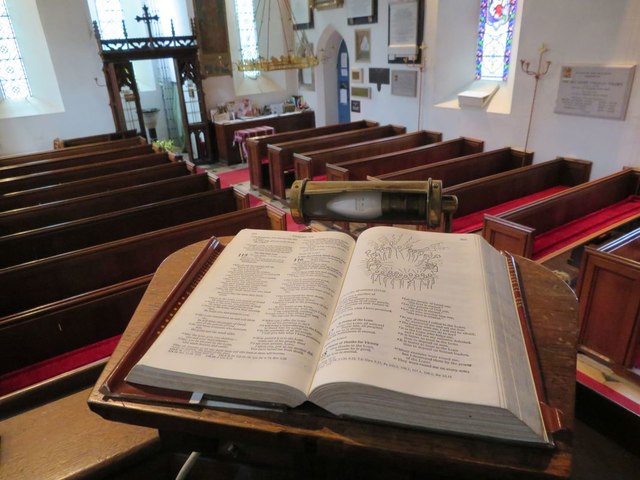
Bible on the pulpit by Bill Nicholls is licensed under CC-BY-SA 2.0

Prepared by William Earnhardt for Sabbath School Class, April 5, 2025.

Main Theme: This week, we will explore some principles that yield a consistent and reliable understanding of prophecy.

Read in Class: Matthew 24:15, Revelation 1:3 Matthew 11:29 and Jeremiah 9:23-24. Ask the class if they see any common threads in these passages.

Study: What do these texts suggest about God’s intention to make Himself understood?

Apply: What are some technigues you have found helpful in understanding the Word of God?

Share: Your friend says she enjoys trying to find “loopholes” in the Word of God. Why may that not be a good idea. What do you tell your friend?

Read in Class: Psalm 139:1-6, Psalm 147:5, Romans 11:33 and 1 John 3:20. Ask the class if they see any common threads in these passages.

Study: What do these passages suggest about God’s understanding in comparison to our own?

Apply: Though, yes, there is much that we don’t know, why is it crucial to focus now on what we do know and to follow what we know—as opposed to obsessing over what we don’t know?

Share: Your friend says his pastor said we should not worry about things we read in the Bible that are not salvation issues. Your friend asks what is meant by salvation issues? What do you tell your friend?

Read in Class: Matthew 5:18, 2 Timothy 3:15-17, and Luke 24:27. Ask the class if they see any common threads in these passages.

Study: What do these verses teach us about the way we ought to approach Bible prophecy?

Apply: What has been your experience with those who use only certain selected texts to try and make their point about, say, the state of the dead? Or even the Sabbath? What is the best way to respond?

Share: Your friend asks if Seventh-day Adventists have any traditions, good or bad, that cannot necesarrily be supported by Scripture? What do you tell your friend?

Read in Class: Daniel 7:7, Daniel 7:24, Revelation 1:16, and Revelation 1:20. Ask the class what common threads they see in these passages.

Study: How does Daniel 7:24 help us understand Daniel 7:7 and how does Revelation 1:20 help us understand Revelation 1:16? Does this show us that the Bible inteprets itself for us?

Apply: Even if some symbols and prophecies remain mysteries, how can focusing on what we do understand strengthen our faith?

Share: Your friend asks why God speaks in symbols instead of just being more literal or forthright? What do you tell your friend?