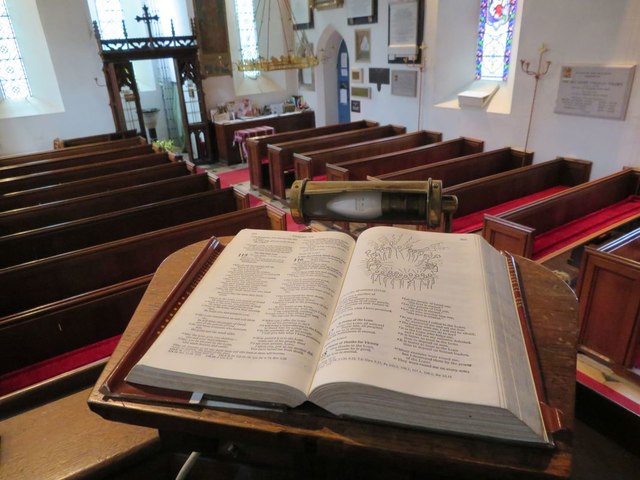
There is a lot of Gospel Theology Packed Into Genesis 3!

Bible on the pulpit by Bill Nicholls is licensed under CC-BY-SA 2.0

As we study Genesis 3 and the fall in this week’s Sabbath School lesson, I am amazed how much Gospel theology is packed into this one chapter. 

In Genesis 3 we find The Plan of Salvation.

The wages of sin is death.

but of the fruit of the tree which is in the midst of the garden, God has said, ‘You shall not eat it, nor shall you touch it, lest you die.’ ” Genesis 3:3 NKJV

We cannot cover our own sin or be saved by our own works.

Then the eyes of both of them were opened, and they knew that they were naked; and they sewed fig leaves together and made themselves coverings.

So he said, “I heard Your voice in the garden, and I was afraid because I was naked; and I hid myself.” Genesis 3:7,10 NKJV

While we cannot save ourselves, God has promised us a Savior.

And I will put enmity Between you and the woman, And between your seed and her Seed; He shall bruise your head, And you shall bruise His heel.” Genesis 3:15 NKJV

While we cannot cover or save ourselves Jesus, the Lamb of of God died to cover our sins and save us.

Also for Adam and his wife the Lord God made tunics of skin, and clothed them. Genesis 3:21 NKJV

In Genesis 3 we find the truth about God’s Word.

While Eve reminds the serpent of God’s Word the serpent casts doubt on God’s word at first, and then turns around and calls God’s Word an outright lie. 

Now the serpent was more cunning than any beast of the field which the Lord God had made. And he said to the woman, “Has God indeed said, ‘You shall not eat of every tree of the garden’?”  And the woman said to the serpent, “We may eat the fruit of the trees of the garden; but of the fruit of the tree which is in the midst of the garden, God has said, ‘You shall not eat it, nor shall you touch it, lest you die.’ ” Then the serpent said to the woman, “You will not surely die. Genesis 3:1-4 NKJV

The serpent then suggests that Eve does not need God’s Word. She can be a god herself and decide for herself what is right and wrong.

For God knows that in the day you eat of it your eyes will be opened, and you will be like God, knowing good and evil.” Genesis 3:5 NKJV

The serpent assures Eve she won’t die for disobeying God. After all, how dare God tell us what is right and wrong, much less give us consequences for having our own opinions and way of doing things! The Serpent tells Eve she will be like God. God makes the rules. God is the judge between right and wrong. If Eve becomes like God she will make the rules and decide for herself what is right and wrong. This was implied in the serpent’s comment to Eve, “you will know both good and evil.” In other words,

She would be a god. She would be a law unto herself. –Ellen White, Christ Triumphant, January 16.

Even with all the deceptions and misrepresentations God’s Word proves true. Adam and Eve died for disobeying.

For dust you are, And to dust you shall return. Genesis 3:19 NKJV 

In Genesis 3 we find the truth about death. 

the serpent’s lie opens the door for spiritualism. 

Then the serpent said to the woman, “You will not surely die.” Genesis 3:4 NKJV

We see that mankind really does die and just returns to dust until the resurrection.

For dust you are, And to dust you shall return. Genesis 3:19 NKJV 

We see that sinners do not have immortality and do not get to live forever.

Then the Lord God said, “Behold, the man has become like one of Us, to know good and evil. And now, lest he put out his hand and take also of the tree of life, and eat, and live forever”— Genesis 3:22 NKJV

We see that angels are not our dead loved ones. We do not become angels when we die. God sends Cherubim angels to guard the garden and yet no one has died yet. Angels are not our dead loved ones. 

So He drove out the man; and He placed cherubim at the east of the garden of Eden, and a flaming sword which turned every way, to guard the way to the tree of life. Genesis 3:24 NKJV.

In Genesis 3 we find an investigative judgment. 

Many throw shade on the Biblical teaching of the investigative judgment, saying God does not need to investigate since He already knows everything. Yet we see an investigation in Genesis 3 even though God already knew everything. Remember the investigation is not for God only. He is offering accountability to the entire universe. At the conclusion of the investigative judgment in Genesis 3 and at the end of days, believing mankind will be justified and Satan will bear the ultimate responsibility for and punishment for sin.

And He said, “Who told you that you were naked? Have you eaten from the tree of which I commanded you that you should not eat?” Then the man said, “The woman whom You gave to be with me, she gave me of the tree, and I ate.” And the Lord God said to the woman, “What is this you have done?” The woman said, “The serpent deceived me, and I ate.” So the Lord God said to the serpent: “Because you have done this, You are cursed more than all cattle, And more than every beast of the field; On your belly you shall go, And you shall eat dust All the days of your life.  And I will put enmity Between you and the woman, And between your seed and her Seed; He shall bruise your head, And you shall bruise His heel.” Genesis 3:11-15 NKJV

Did I miss anything? Can you find anymore Gospel theology in Genesis chapter 3? 

Christmas in Light of the Cross, Day 14 (Sanctification in Christmas Carols)

I am writing today from the beautiful Tampa Bay area.

I am writing today from the beautiful Tampa Bay area.

God rest ye merry, gentlemen
Let nothing you dismay
Remember, Christ, our Saviour
Was born on Christmas day
To save us all from Satan’s power
When we were gone astray
O tidings of comfort and joy,
Comfort and joy
O tidings of comfort and joy-Published by William B. Sandys in 1833. Author unknown.

There is some good theology in these older Christmas carols as well as some of the new.

The writer of “God Rest Ye Merry Gentlemen” knew the power of the gospel when he (or she) wrote, “To save us all from Satan’s power when we were gone astray.”  By coming to live and die for us, Jesus did way more than just save us from the penalty of sin. He saves us from the power of sin.

The author of “Away in a Manger” (Author unknown) Speaks of sanctification as well as justification.

Bless all the dear children in thy tender care, And fit us for heaven, to live with thee there.

That’s what sanctification is, fitting us for heaven and saving us from Satan’s power. (Some newer versions of this song say “take us to heaven” instead of “fit us for heaven.” Why the change? Conspiracy? LOL!) Today as Seventh-day Adventists study and share the sanctuary message, many scoff at us when it comes to the holy place and most holy place, where sanctification takes place. They want the sanctuary to end in the courtyard where justification takes place, and not go any farther. Yet years before the Adventists ever discovered the “cleansing of the sanctuary” message, these and many other Christmas hymns had an understanding of the complete gospel, and a comprehension of all that Jesus accomplished by His life and death on the cross, and what He can accomplish in our hearts today!

“And she will bring forth a Son, and you shall call His name Jesus, for He will save His people from [From not in!] their sins.” Matthew 1:21 NKJV

This Christmas Season let’s take some time to enjoy and appreciate the wonderful Christmas hymns, celebrating everything Jesus accomplished for us from the manger to the cross!

John 20; The Bible Was not Written for Debate

I am writing today from the beautiful Tampa Bay area.

John 20:31   But these are written, that ye might believe that Jesus is the Christ, the Son of God; and that believing ye might have life through his name. 

I meet many people who love to debate the gospels and even the whole Word of God. Others love to speculate as to what it certain symbols mean. However they do this with no conviction of the truth but just out of curiosity as though the Bible were some fiction mystery book. I do not like to waste my time with debates. I want to share the things that are written in God’s Word with a world that is feels its need of a Savior, and not waste my time debating it with fiction and novel lovers.

We need far less controversy, and far more presentation of Christ. Our Redeemer is the center of all our faith and hope. Those who can present His matchless love, and inspire hearts to give Him their best and holiest affections, are doing work that is great and holy.–Colporteur Evangelist, pp. 60, 61.

-In the presentation of unpopular truth, which involves a heavy cross, preachers should be careful that every word is as God would have it. Their words should never cut. They should present the truth in humility, with the deepest love for souls, and an earnest desire for their salvation, and let the truth cut. They should not defy ministers of other denominations, and seek to provoke a debate. They should not stand in a position like that of Goliath when he defied the armies of Israel. Israel did not defy Goliath but Goliath made his proud boasts against God and His people. The defying, the boasting, and the railing must come from the opposers of truth, who act the Goliath. But none of this spirit should be seen in those whom God has sent forth to proclaim the last message of warning to a doomed world. . . .  } 

     If they, like David, are brought into a position where God’s cause really calls for them to meet a defier of Israel, and if they go forth in the strength of God, relying wholly upon Him, He will carry them through, and cause His truth to triumph gloriously. Christ has given us an example. “Yet Michael the Archangel, when contending with the devil he disputed about the body of Moses, durst not bring against him a railing accusation, but said, The Lord rebuke thee.”–Testimonies, vol. 3, pp. 218-220.

Luke 6; Rock or Earth

I am writing tonight from the beautiful Tampa Bay area.

Luke 6:46 And why call ye me, Lord, Lord, and do not the things which I say? 
 6:47 Whosoever cometh to me, and heareth my sayings, and doeth them, I will show you to whom he is like: 
 6:48 He is like a man which built an house, and digged deep, and laid the foundation on a rock: and when the flood arose, the stream beat vehemently upon that house, and could not shake it: for it was founded upon a rock. 
 6:49 But he that heareth, and doeth not, is like a man that without a foundation built an house upon the earth; against which the stream did beat vehemently, and immediately it fell; and the ruin of that house was great. 

 This passage reminds us that, The Bible must change how we live our lives. Too often though we let the way we live our lives change how we interpret the Bible.


Often on my day off I go somewhere where I can spend some time alone with God. A while back I went to Siesta Beach in Sarasota . I waded into the water and as a wave rushed to shore it moved the sand right out from under my feet. The sand quickly shifted to conform to its surroundings. I realized that was what Jesus was talking about when He said to not build your house on the sand. Our theology and Christian walk should not be like the sand that conforms to our surroundings.


Jesus wants us our experience to be like the rock. Instead of the rock conforming to its environment, the environment conforms to the rock. Chitons are rock-clinging marine mollusks that are found on rocky coasts all over the world. These shells cling to the rock and conform themselves to the rock. Otherwise they get washed out to sea. In order to survive we must conform to the rock which is God’s Word.  In order to survive we must let the Bible change us and not our surroundings and environment.  We must let the Bible change how we look at the world and not let the world change how we look at the Bible.