There is a lot of Gospel Theology Packed Into Genesis 3!

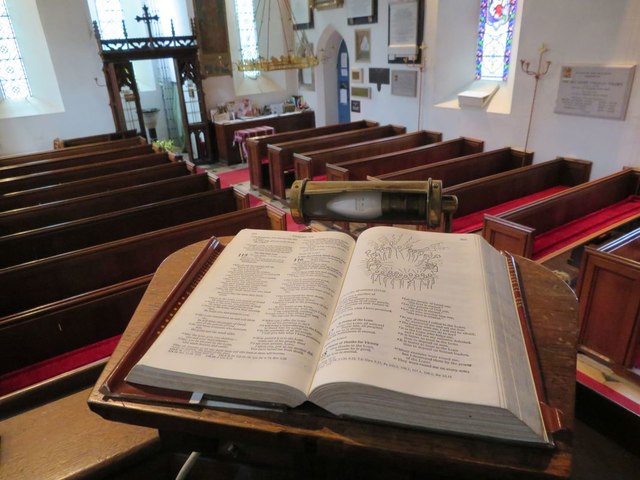
Bible on the pulpit by Bill Nicholls is licensed under CC-BY-SA 2.0

As we study Genesis 3 and the fall in this week’s Sabbath School lesson, I am amazed how much Gospel theology is packed into this one chapter. 

In Genesis 3 we find The Plan of Salvation.

The wages of sin is death.

but of the fruit of the tree which is in the midst of the garden, God has said, ‘You shall not eat it, nor shall you touch it, lest you die.’ ” Genesis 3:3 NKJV

We cannot cover our own sin or be saved by our own works.

Then the eyes of both of them were opened, and they knew that they were naked; and they sewed fig leaves together and made themselves coverings.

So he said, “I heard Your voice in the garden, and I was afraid because I was naked; and I hid myself.” Genesis 3:7,10 NKJV

While we cannot save ourselves, God has promised us a Savior.

And I will put enmity Between you and the woman, And between your seed and her Seed; He shall bruise your head, And you shall bruise His heel.” Genesis 3:15 NKJV

While we cannot cover or save ourselves Jesus, the Lamb of of God died to cover our sins and save us.

Also for Adam and his wife the Lord God made tunics of skin, and clothed them. Genesis 3:21 NKJV

In Genesis 3 we find the truth about God’s Word.

While Eve reminds the serpent of God’s Word the serpent casts doubt on God’s word at first, and then turns around and calls God’s Word an outright lie. 

Now the serpent was more cunning than any beast of the field which the Lord God had made. And he said to the woman, “Has God indeed said, ‘You shall not eat of every tree of the garden’?”  And the woman said to the serpent, “We may eat the fruit of the trees of the garden; but of the fruit of the tree which is in the midst of the garden, God has said, ‘You shall not eat it, nor shall you touch it, lest you die.’ ” Then the serpent said to the woman, “You will not surely die. Genesis 3:1-4 NKJV

The serpent then suggests that Eve does not need God’s Word. She can be a god herself and decide for herself what is right and wrong.

For God knows that in the day you eat of it your eyes will be opened, and you will be like God, knowing good and evil.” Genesis 3:5 NKJV

The serpent assures Eve she won’t die for disobeying God. After all, how dare God tell us what is right and wrong, much less give us consequences for having our own opinions and way of doing things! The Serpent tells Eve she will be like God. God makes the rules. God is the judge between right and wrong. If Eve becomes like God she will make the rules and decide for herself what is right and wrong. This was implied in the serpent’s comment to Eve, “you will know both good and evil.” In other words,

She would be a god. She would be a law unto herself. –Ellen White, Christ Triumphant, January 16.

Even with all the deceptions and misrepresentations God’s Word proves true. Adam and Eve died for disobeying.

For dust you are, And to dust you shall return. Genesis 3:19 NKJV 

In Genesis 3 we find the truth about death. 

the serpent’s lie opens the door for spiritualism. 

Then the serpent said to the woman, “You will not surely die.” Genesis 3:4 NKJV

We see that mankind really does die and just returns to dust until the resurrection.

For dust you are, And to dust you shall return. Genesis 3:19 NKJV 

We see that sinners do not have immortality and do not get to live forever.

Then the Lord God said, “Behold, the man has become like one of Us, to know good and evil. And now, lest he put out his hand and take also of the tree of life, and eat, and live forever”— Genesis 3:22 NKJV

We see that angels are not our dead loved ones. We do not become angels when we die. God sends Cherubim angels to guard the garden and yet no one has died yet. Angels are not our dead loved ones. 

So He drove out the man; and He placed cherubim at the east of the garden of Eden, and a flaming sword which turned every way, to guard the way to the tree of life. Genesis 3:24 NKJV.

In Genesis 3 we find an investigative judgment. 

Many throw shade on the Biblical teaching of the investigative judgment, saying God does not need to investigate since He already knows everything. Yet we see an investigation in Genesis 3 even though God already knew everything. Remember the investigation is not for God only. He is offering accountability to the entire universe. At the conclusion of the investigative judgment in Genesis 3 and at the end of days, believing mankind will be justified and Satan will bear the ultimate responsibility for and punishment for sin.

And He said, “Who told you that you were naked? Have you eaten from the tree of which I commanded you that you should not eat?” Then the man said, “The woman whom You gave to be with me, she gave me of the tree, and I ate.” And the Lord God said to the woman, “What is this you have done?” The woman said, “The serpent deceived me, and I ate.” So the Lord God said to the serpent: “Because you have done this, You are cursed more than all cattle, And more than every beast of the field; On your belly you shall go, And you shall eat dust All the days of your life.  And I will put enmity Between you and the woman, And between your seed and her Seed; He shall bruise your head, And you shall bruise His heel.” Genesis 3:11-15 NKJV

Did I miss anything? Can you find anymore Gospel theology in Genesis chapter 3? 

12: Receiving an Unshakeable Kingdom-Sabbath School Teaching Plan

Photo by EKATERINA BOLOVTSOVA on Pexels.com

Prepared by William Earnhardt, for Sabbath School Class, Sabbath, March 19,2022.

Main Theme: Jesus has received a kingdom and is going to share it with us.

Read Together: Hebrews 12:22-24 and Daniel 7:13-14. Define the main idea of these passages.

Study: If this is a celebration, why is God described as a judge? How can a judge be part of or a reason for a celebration?

Apply: How does what we studied today help us understand that God’s judgment in the three angels’ messages is “good news” for this time (Rev. 14:67; compare with Deut. 32:361 Chron. 16:33-35)?

Share: Your friend tells you the judgement scares them? What hope can you share with your friend?

Read Together: Hebrews 12:26-27 and Psalm 96:9-10. Define the main idea of these passages.

Study: What is the purpose of God’s shaking the heavens and the earth? What does this mean?

Apply: Why is the promise that one day justice will be done, and the evil that has been so prevalent in our world will one day be destroyed, such a hopeful promise for us all, especially those who have suffered directly at the hands of evil?

Share: Your friend has watched too many mystery shows, and laments to you how so many people have gotten away with such heinous crimes without ever being brought to justice. How do you respond to your friend?

Read Together: Hebrews 12:27, Psalm 21:7 and Psalm 62:2. Define the main idea of this passage.

Study: What are the things that will not be shaken?

Apply:  How well are you doing now in terms of being shaken or not shaken? What choices can you make to get help in being unmoved? Share your thoughts.

Share: A church member asks, “How do we know we will not be shaken out? Will whole churches be shaken? If so, what hope do we have?” How do you respond to your fellow church member?

Read Together: Hebrews 12:28 and Hebrews 13:15-16. Define the main idea of these passages.

Study: How do we offer God acceptable worship?

Apply:  How could our spiritual sacrifices to God be corrupted? Share your thoughts.

Share: Who can you invite to Sabbath School next week?

“During the thousand years between the first and the second resurrection the judgment of the wicked takes place. The apostle Paul points to this judgment as an event that follows the second advent. ‘Judge nothing before the time, until the Lord come, who both will bring to light the hidden things of darkness, and will make manifest the counsels of the hearts.’ 1 Corinthians 4:5. Daniel declares that when the Ancient of Days came, ‘judgment was given to the saints of the Most High.’ Daniel 7:22. At this time the righteous reign as kings and priests unto God. John in the Revelation says: ‘I saw thrones, and they sat upon them, and judgment was given unto them.’ ‘They shall be priests of God and of Christ, and shall reign with Him a thousand years.’ Revelation 20:46. It is at this time that, as foretold by Paul, ‘the saints shall judge the world.’ 1 Corinthians 6:2. In union with Christ they judge the wicked, comparing their acts with the statute book, the Bible, and deciding every case according to the deeds done in the body. Then the portion which the wicked must suffer is meted out, according to their works; and it is recorded against their names in the book of death.

Satan also and evil angels are judged by Christ and His people. Says Paul: ‘Know ye not that we shall judge angels?’ Verse 3. And Jude declares that ‘the angels which kept not their first estate, but left their own habitation, He hath reserved in everlasting chains under darkness unto the judgment of the great day.’ Jude 6.” — Ellen G. White, The Great Controversy, pp. 660, 661.

The Cleansing of the Sanctuary in Light of the Cross

williams-picture2.jpg

I am writing tonight from the beautiful Tampa Bay area.

When people ask me why Adventists do not keep the feast days, I tell them we do-literally! At the cross we had the literal Passover. Ever since 1844 we have been living in the literal Day of Atonement. When Jesus returns it will literally be the Feast of Trumpets. As Colossians 2:14-17  points out, we do not need to keep the feast Sabbaths which were a shadow of things to come, because now we had the literal Passover when Jesus died on the cross. Now we are living in the literal Day of Atonement.

I have heard people say there is no such thing as a literal Day of Atonement, but that makes no sense to me, because how can there be a shadow to something that doesn’t even exist? Also the sanctuary building itself shows me there has to be a literal Day of Atonement and cleansing of the sanctuary. The sanctuary is an illustration of the Gospel. Many try to tell me the Gospel ended at the cross. If that is so then the sanctuary would have ended in the courtyard where the sacrifice was slain. The fact that the sanctuary continues to a holy and most holy place, tells me the Gospel goes beyond a literal cross into a literal holy and most holy place.  Besides, if the Passover had a literal cross and the Feast of Trumpets has a literal second coming then reason tells me the Day of Atonement must have a literal Day of Atonement as well.

A friend pointed out to me that there was no reason for a literal Day of Atonement beginning in 1844 because sins were forgiven and cleansed right away. There was no need for a cleansing of the sanctuary . yet peter refers to a future day of refreshing or cleansing of sin still to come.

Repent ye therefore, and be converted, that your sins may be blotted out, when the times of refreshing shall come from the presence of the Lord. Acts 3:19 KJV

The Message Translation refers to a work still to be done by Jesus in the heavenly sanctuary.

“Now it’s time to change your ways! Turn to face God so he can wipe away your sins, pour out showers of blessing to refresh you, and send you the Messiah he prepared for you, namely, Jesus. For the time being he must remain out of sight in heaven until everything is restored to order again just the way God, through the preaching of his holy prophets of old, said it would be. Moses, for instance, said, ‘Your God will raise up for you a prophet just like me from your family. Listen to every word he speaks to you. Every last living soul who refuses to listen to that prophet will be wiped out from the people.’ Acts 3;19-23 The Message

Still I have heard people say there is no reason for a Day of Atonement or investigative judgment because God already knows everything and does not need to investigate. However in Genesis 3 God comes into the Garden of Eden to investigate after Adam and Eve disobeyed. Again in Genesis 18:21 God investigates Sodom and Gomorrah. So we cannot say there is no investigation because God already knows. Besides, all arguments aside, Daniel 8:14 says after 2300 days (a day for a year Ezekiel 4:6) the sanctuary shall be cleansed. The prophecy of Daniel 8 and 9 mesh together. If you try to make the cleansing of the sanctuary in 2300 literal days then

you have to make the coming of the Messiah in 483 literal days which would make it impossible for Jesus to be our Messiah and Savior. But as Daniel 8 and 9 clearly teach, in A.D. 27 at the beginning of the 70th week, Jesus came as our Messiah and in 1844 He entered the Most Holy Place in heaven to complete the Gospel with the Day of Atonement and Cleansing of the Sanctuary.

The Old Testament Day of Atonement was a shadow or illustration of what would occur during the literal Day of Atonement when Jesus entered the Most Holy Place for us. Let’s take a look.

What was to happen at the end of the 2300 days?

The other replied, “It will take 2,300 evenings and mornings; then the Temple will be made right again.” Daniel 8:14 NLT And he said unto me, Unto two thousand and three hundred days; then shall the sanctuary be cleansed. Daniel 8:14 KJV

Note: The Bible refers to two sanctuaries, one on earth and the other in heaven.

After what, was Moses to build the sanctuary?

“Have the people of Israel build me a holy sanctuary so I can live among them. You must build this Tabernacle and its furnishings exactly according to the pattern I will show you. Exodus 25:8- 9 NLT

Where is the location of the original?

Here is the main point: We have a High Priest who sat down in the place of honor beside the throne of the majestic God in heaven. There he ministers in the heavenly Tabernacle,the true place of worship that was built by the Lord and not by human hands. Hebrews 8:1-2 NLT

They serve in a system of worship that is only a copy, a shadow of the real one in heaven. For when Moses was getting ready to build the Tabernacle, God gave him this warning: “Be sure that you make everything according to the pattern I have shown you here on the mountain.” Hebrews 8:5 NLT

How many apartments did it have?

Hang the inner curtain from clasps, and put the Ark of the Covenant in the room behind it. This curtain will separate the Holy Place from the Most Holy Place.Exodus 26:33 NLT

When these things were all in place, the priests regularly entered the first room as they performed their religious duties. Hebrews 9:6 NLT

How frequent was it in the second apartment?

But only the high priest ever entered the Most Holy Place, and only once a year. And he always offered blood for his own sins and for the sins the people had committed in ignorance. Hebrews 9:7 NLT

When did the high priest do this?

“On the tenth day of the appointed month in early autumn, you must deny yourselves. Neither native-born Israelites nor foreigners living among you may do any kind of work. This is a permanent law for you. Leviticus 16:29 NLT

What was he doing?

On that day offerings of purification will be made for you, and you will be purified in the Lord’s presence from all your sins. Leviticus 16:30 NLT

How did he do it?

Then he must take the two male goats and present them to the Lord at the entrance of the Tabernacle. He is to cast sacred lots to determine which goat will be reserved as an offering to the Lord and which will carry the sins of the people to the wilderness of Azazel. Aaron will then present as a sin offering the goat chosen by lot for the Lord. Leviticus 16:7-9 NLT

What did he do with the blood?

“Then Aaron must slaughter the first goat as a sin offering for the people and carry its blood behind the inner curtain. There he will sprinkle the goat’s blood over the atonement cover and in front of it, just as he did with the bull’s blood. Through this process, he will purify the Most Holy Place, and he will do the same for the entire Tabernacle, because of the defiling sin and rebellion of the Israelites. Leviticus 16:15-16 NLT

What did he do with the sins?

“When Aaron has finished purifying the Most Holy Place and the Tabernacle and the altar, he must present the live goat. He will lay both of his hands on the goat’s head and confess over it all the wickedness, rebellion, and sins of the people of Israel. In this way, he will transfer the people’s sins to the head of the goat. Then a man specially chosen for the task will drive the goat into the wilderness. As the goat goes into the wilderness, it will carry all the people’s sins upon itself into a desolate land. Leviticus 16:20-22 NLT

Note: For more on the scapegoat click here.

What were the people to be doing?

“Be careful to celebrate the Day of Atonement on the tenth day of that same month—nine days after the Festival of Trumpets. You must observe it as an official day for holy assembly, a day to deny yourselves and present special gifts to the Lord. Do no work during that entire day because it is the Day of Atonement, when offerings of purification are made for you, making you right with[the Lord your God. All who do not deny themselves that day will be cut off from God’s people. Leviticus 23:27-29 NLT

What happened to those living willfully in open sin?

All who do not deny themselves that day will be cut off from God’s people. And I will destroy anyone among you who does any work on that day. Leviticus 23:29-30 NLT

Note: Jesus has begun the cleansing of the heavenly sanctuary or the blotting out of the record of confessed sins there, as well as from our lives here.

What pronouncement will Jesus soon make?

Let the one who is doing harm continue to do harm; let the one who is vile continue to be vile; let the one who is righteous continue to live righteously; let the one who is holy continue to be holy.” “Look, I am coming soon, bringing my reward with me to repay all people according to their deeds. Revelation 22:11- 12 NLT

What happens to those still sinning willfully?

And God will provide rest for you who are being persecuted and also for us when the Lord Jesus appears from heaven. He will come with his mighty angels, in flaming fire, bringing judgment on those who don’t know God and on those who refuse to obey the Good News of our Lord Jesus. They will be punished with eternal destruction, forever separated from the Lord and from his glorious power. 2 Thessalonians 1:7-9 NLT

What happens to the righteous?

For the Lord himself will come down from heaven with a commanding shout, with the voice of the archangel, and with the trumpet call of God. First, the Christians who have died will rise from their graves. Then, together with them, we who are still alive and remain on the earth will be caught up in the clouds to meet the Lord in the air. Then we will be with the Lord forever. 1 Thessalonians 4:16-17 NLT

Which group will you be found in?

“Not everyone who calls out to me, ‘Lord! Lord!’ will enter the Kingdom of Heaven. Only those who actually do the will of my Father in heaven will enter. On judgment day many will say to me, ‘Lord! Lord! We prophesied in your name and cast out demons in your name and performed many miracles in your name.’ But I will reply, ‘I never knew you. Get away from me, you who break God’s laws.’ “Anyone who listens to my teaching and follows it is wise, like a person who builds a house on solid rock. Though the rain comes in torrents and the floodwaters rise and the winds beat against that house, it won’t collapse because it is built on bedrock. But anyone who hears my teaching and doesn’t obey it is foolish, like a person who builds a house on sand. When the rains and floods come and the winds beat against that house, it will collapse with a mighty crash.” Matthew 7:21-27 NLT

What should we be doing in this time of judgment?

“Fear God,” he shouted. “Give glory to him. For the time has come when he will sit as judge. Worship him who made the heavens, the earth, the sea, and all the springs of water.” Revelation 14:7 NLT

What assurance do we have?

So then, since we have a great High Priest who has entered heaven, Jesus the Son of God, let us hold firmly to what we believe. This High Priest of ours understands our weaknesses, for he faced all of the same testings we do, yet he did not sin. So let us come boldly to the throne of our gracious God. There we will receive his mercy, and we will find grace to help us when we need it most. Hebrews 4:14-16 NLT

Related reading: Was the atonement made to appease an angry God or an angry race?  

You may study this week’s Sabbath School lesson here. 
From Disappointment to Discovery!

I am writing today from the beautiful Tampa Bay area.

I am writing today from the beautiful Tampa Bay area.

In 1492 Columbus sailed the ocean blue, and while he thought he was finding a short cut to India what he found was a whole “new world.” Now granted, the millions of people already living there already knew about it, and there is evidence of visitors well before Columbus. Still that does not change the point of this story. The fact is that while Columbus’ calculations were off, and his trip a “disappointment” as far as finding a new way to India, he still discovered for himself a whole new world!

In 1844 a group of Bible students also had some miscalculations, but even though they had a disappointment they still discovered something very new to them.

So I went to the angel and told him to give me the small scroll. “Yes, take it and eat it,” he said. “It will be sweet as honey in your mouth, but it will turn sour in your stomach!” So I took the small scroll from the hand of the angel, and I ate it! It was sweet in my mouth, but when I swallowed it, it turned sour in my stomach.Revelation 10:9-10

Seventh-day Adventists understand this passage to be referring to the great disappointment in 1844, when the Millerites expected Jesus to come. The scroll is the book of Daniel which contains the 2300 day prophecy, and the sweetness was the expectation of his coming in 1844 and the bitterness is the disappointment.

Some believe that the seven thunders (see Revelation 10:4) actually told John about the great disappointment, but when he went to write it he was told not to. If you go with this theory, then you understand that some things must be learned through experience. Sometimes that is the best way to learn, and it is not that God had not already told us that we do not know the day, or the hour of the second coming. There was enough Biblical evidence already in the Scriptures to prevent the great disappointment from happening. Sometimes we have to take our lumps for not appreciating what Biblical evidence is already there, and learn from experience.

Remembering that there were no chapter divisions in the original Scriptures, the first two verses of Revelation 11 give us a strong clue as to what actually happened in 1844.

Then I was given a measuring stick, and I was told, “Go and measure the Temple of God and the altar, and count the number of worshipers.  But do not measure the outer courtyard, for it has been turned over to the nations. Revelation 11:1-2 NLT

What these Bible students discovered after their great disappointment was the wonderful truth about the investigative judgment and cleansing of the sanctuary!

Still, that did not take away the sting of the great disappointment.

Here is the account of one of the Millerites, Hiram Edson of that great disappointment when Jesus did not return in October 22, 1844:

“Our fondest hopes and expectations were blasted, and such a spirit of weeping came over us as I never experienced before. It seemed that the loss of all earthly friends could have been no comparison. We wept, and wept, till the day dawn.” -Christ and His sanctuary, Page 4.

Many people mocked Hiram and his friends while they were already grieving. Does that make any sense to you? Making fun of hurting people, just because they made an honest mistake in misunderstanding the Bible?

1844 was not the first time such a thing happened. After the crucifixion, God’s true followers, the disciples, were severely disappointed. Of course their disappointment came from their misunderstanding of Jesus’ clear words. Still pain is pain, and there was no reason to make fun of them while they were hurting. And their mistake in misunderstanding and not comprehending the Scriptures regarding the cross, did not stop them from still being true disciples of Jesus! They were still God’s people even though they still had a lot to learn, some of which they would have to learn by going through bitter disappointments, and even what they (both the disciples in A.D. 31 and A.D. 1844) perceived as public embarrassment, in addition to grief.

I want to make two points here.

  1.  We should never make fun or mock people who misunderstand the Scriptures. Since 1844 other people have set dates for the second coming and been sorely disappointed, and I hear Adventists joking, poking fun at them for not realizing that Jesus says nobody knows the day of the hour of His return. So they should have known better, so should William Miller and the Bible students of his day. Still, why are some Christians, more eager to mock people’s pain rather than sympathize with them! Telling someone “You should have known better” does not ease the pain. It only makes it worse. When the shepherd finds the lost sheep, and binds up his wounds, I don’t recall the shepherd ever telling the sheep “Hey you made a mistake! This is your own fault!” Such words would bring no healing for the wounds. We are told to cry with those who cry, instead of making fun of them.
  2. Hiram and his friends were heartbroken when Jesus did not return. He wrote, “our fondest hopes were blasted.”Is Jesus coming soon your fondest hope? Would you rather be with Jesus than with all your friends on earth? Dare, I ask, are some of us even relieved that Jesus has not come yet? Do some of us find a delay, whether real or apparent, as no disappointment whatsoever?  Is the second coming of Jesus your fondest hope, or are you relieved instead of disappointed that He has not come yet?

On the cross, there was a thief who was mocking Jesus and making fun of all of His claims. This thief was belligerent and would have just as easily mocked Jesus’ followers. But somewhere in the midst of that dark afternoon, this thief stopped mocking Jesus and started looking at his own heart. When he did, an amazing revival took place. Maybe it would be a good idea for us, instead of mocking the claims and theology of others, to take a good look at our own hearts, and our own attitudes about meeting Jesus one day soon.

You may explore this week’s Sabbath School lesson here.