Main Theme: Genesis 18 gives us Abraham as a model of how God can use us in His mission.
Read in Class: Genesis 18:16-33. Define the main idea of this passage.
Study: How did Abraham exercise his great quality of love for all people without distinguishing tribe, race, or people?
Apply: Why is intercessory prayer so important in our own prayer life? How can praying for others in need help us grow spiritually and experience more the reality of God’s love for sinners?
Share: Your friend asks what good it does to pray for the salvation of those around us? Isn’t God already doing all He can to save the world? How could our prayers possibly help God when He is already doing everything possible to save us?
Study: What should this teach us about the power of intercessory prayer?
Apply: Read Romans 8:34; Hebrews 7:25. What do they tell us about what Jesus does for us, and how might this truth help us understand better our own role as intercessors for others?
Share: Your friend asks how God has answered your prayers regarding the salvation of others? What do you tell your friend?
Read in Class: Genesis 19:1-29. Define the main idea of this passage.
Study: What was the result of Abraham’s spirit of hospitality, love, and prayer?
Apply: How can we learn not to be discouraged if we are not seeing the kind of results that we want when we do mission? See That’s Why I’m Here.
Share: Your friend asks, “How do we convince such a sinful generation that they need a Savior without making them feel condemned?” What do you tell your friend?
Read in Class: Genesis 12:1-9. Define the main idead of this passage.
Study: What do these verses teach about submitting to God’s will, even when the path ahead does not seem clear?
Challenge: Challenge: In our cities, we face obstacles in preaching the gospel appropriately and effectively. We need to plead with God to intervene.
Challenge up: Find a way to contact someone who is being directly affected by a difficult situation similar to your own. Tell that person you are praying for him or her, and ask God to show you what you can do to help.
The late evangelist Ron Halverson told a story of him knocking on a door one night in Harlem, New York. A young woman answered the door. She had grown up a pastor’s daughter, but had become a prostitute. The woman looked at the Bible in Halverson’s hand and said, “I’m not interested!” Quick-witted Halverson responded as she tried to slam the door, “I know you’re not interested! That’s why I’m here!”
Granted, such an approach would not normally work, but this time it woke the young lady up to a need she had been neglecting. Sometimes we look at our mission field and think the grass is greener in other mission fields. Fact is, the green mission fields don’t need us as much as the parched fields do. The young lady, who answered the door to Pastor Halverson, may not have looked promising, but she actually needed his message more than anyone else in Harlem that night.
Once I was working in a church that seemed just as worldly as the … well, world! The youth teachers openly confessed to me that they entertained the kids instead of teaching them, because they themselves did not know anything about the Bible. When I held evangelistic meetings, the greeters were never around to hand out lesson outlines, because they went home when the meetings started! The musicians would come in and play before my presentation, and everyone would watch as they walked out and went home as soon as they were through playing. An elder in the church told me that his neighbor wanted to come to the meetings and would I please give him a ride. I asked the elder why he could not just bring his neighbor to the meetings himself, since, after all, they lived right next-door. The elder told me he would not be coming to the meetings since he had already heard it all before. It was very discouraging!
I asked God why he sent me to such a spiritually parched church. God told me that it was because the church was my mission field just as much as the community. This changed my attitude, and instead of getting upset because the youth leaders did not know their Bibles, I took advantage of the opportunity to teach them about the Bible and Jesus. The leaders in the church became my mission field. Before long God sent other missionaries more skilled than myself, to help turn the church around. When I left, the church was not at all like I first found it. Thanks to God and the other missionaries He sent, the youth leaders grew (and sadly some left) and there was a totally different spiritual climate in the entire church family.
I would rather have been in a church where the youth teachers knew their Bibles and the members were are on fire to do evangelism, but you know what? A church like that would not have needed me as much as this one did. While it may be easier and a lot more fun to work with people who are spiritually mature and on fire for the Lord, Pastor Halverson realized he was needed where people did not seem interested. I learned the same lesson.
When I was 11, I started piano lessons but quit after just a few weeks. A few years ago, at the age of 48 I started taking lessons again. So I don’t like to say I actually quit when I was 11. I just took a 37-year sabbatical. When I started again, my teacher just happened to be a college musician who I actually met a few years ago when she was only 11. She is more than young enough to be my daughter. Fact is, if I had stayed with my piano lessons when I was 11, I might have been able to teach her instead of her teaching me. Instead, at the age of 48 I began taking piano lessons from a 19-year-old. She’s never said anything like, “You are almost 50. You should know all this by now.” She never said, “Look at how old you are. You should be teaching me, but instead I am teaching you.” Instead she enthusiastically seized the opportunity to teach me in the here and now.
Sometimes we get discouraged when we see people in the church who we think should know more by now. Maybe they should, but instead of getting discouraged, let’s seize the opportunity to teach. I need a good teacher like my piano teacher, because I don’t have it all together. I struggle with my timing, among other things, so I need a good teacher. If I was a polished musician I would not need her. If everyone in the church already knew their Bibles and had it all together they would not need me. There may be more gifted musicians in the world that are easier to teach than I am, but it is because I am not a gifted musician that I need my piano teacher so much.
So if your mission field looks parched and pitiful, and you are tempted to think the grass would be greener in another mission field, remember, a greener mission field would not need you, like the parched pitiful mission field does. If you look around your mission field and don’t see much potential or interest just remember what Pastor Halverson remembered – that’s why you’re here!
You may study this week’s Sabbath School lesson here.
Study: What were the intentions of the people? What were they wanting to do, and why would God thwart it? In what way was God’s instruction to Abram a call to mission?
Apply: Are you part of a group or ethnic community that is more comfortable among themselves? In what ways may you possibly engage with others who are not part of your race, ethnicity, or nationality?
Share: Your friend asks you if God has ever sent you out of your comfort zone to accomplish a mission? What was the mission and how did it go?
Read in Class: Genesis 12:1-13:1. Define the main idea of this passage.
Study: What things happened to him next, and what mistakes did this man of God make?
Apply: What lessons can we take from the story about Abram in Egypt?
Share: Your friend asks, “What if God calls us somewhere were there is not much potential and things look pretty hopeless? How do we know God is calling us, will be with us, and we will be successful?”
Read in Class: Acts 8:1-4. Define the key thought in this passage.
Study: In the early church, what brought about the scattering of believers beyond their comfort zone?
Apply: In what ways could you, daily, express mission in your attitude and behavior? How could you be more mission-minded in your daily tasks?
Share: Your friend asks, “Does God always use persecution to get us out of our comfort zones to complete the mission? Does God ever use us in our comfort zones?” What do you tell your friend?
Read in Class: Acts 1:8. Define the main idea of this passage.
Study: What principle did Jesus present when doing the work of sharing or being His witnesses to the world?
Challenge: Identify and make a list of people groups with special needs in your community, whom the church has not made efforts to reach. Challenge Up: Begin praying for an opportunity in the near future to become engaged in mission to people with special needs.
Share: How may God be calling you out of your comfort zone to share in His mission? Are you willing be called out of your comfort zone this week?
Go therefore and make disciples of all the nations, baptizing them in the name of the Father and of the Son and of the Holy Spirit, teaching them to observe all things that I have commanded you; and lo, I am with you always, even to the end of the age.” Amen. Matthew 28:19-20 NKJV
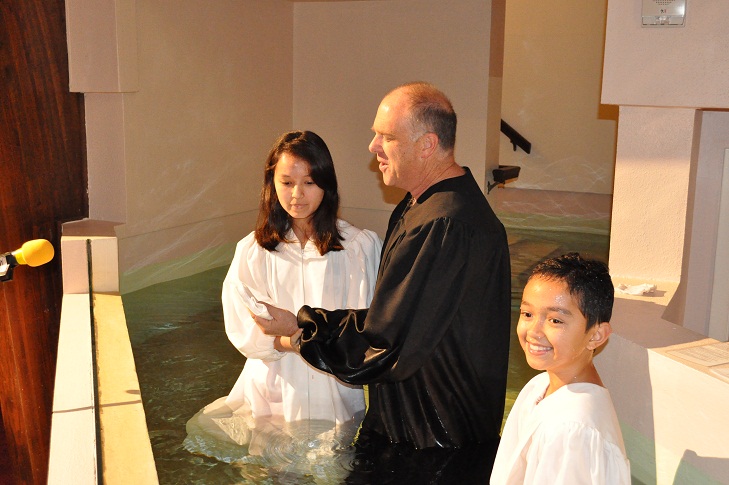
Many people ask, why the Seventh-day Adventist Church has people go though an entire series of Bible studies before baptism? It is because Jesus tells us to “teach them to observe all things I have commanded you.” This cannot be done in one or two sittings. So why did Philipp baptize the Ethiopian after just one Bible study? Keep in mind that the Ethiopian, as many people were in his time and place, was aware of the seventh-day Sabbath, clean and unclean foods, as well as other Bible standards. Even today there are people we may be baptized sooner than others because of what they have already learned. I have had people come to my church who have been watching programs like It is Written for several years, and as I interview them I find they are already quite capable of explaining many doctrines from the Bible. That allows us to move on to other topics they may not be as familiar with.
Baptism is a major decision in one’s life – even greater than marriage or a career, as being a baptized disciple of Christ will have a major impact on who we marry and even on the way we perform our work or careers. Just like we do not want to rush into marriage without knowing what we are doing, or choose a career without being properly trained and informed about everything that career includes and demands, we need to have a clear understanding of what it means to be a baptized disciple. Jesus tells us right up front this not a decision to be made nonchalantly.
A large crowd was following Jesus. He turned around and said to them, “If you want to be my disciple, you must, by comparison, hate everyone else—your father and mother, wife and children, brothers and sisters—yes, even your own life. Otherwise, you cannot be my disciple. And if you do not carry your own cross and follow me, you cannot be my disciple. “But don’t begin until you count the cost. For who would begin construction of a building without first calculating the cost to see if there is enough money to finish it? Luke 14:25-28 NLT
Of course we do not know everything when are baptized. We will be learning throughout eternity, but those considering baptism should be taught enough from God’s Word so they can count the cost and have a thorough enough understanding of what it means to be a baptized disciple of Christ.
Ministers who labor in towns and cities to present the truth should not feel content, nor that their work is ended, until those who have accepted the theory of the truth realize indeed the effect of its sanctifying power, and are truly converted to God. God would be better pleased to have six truly converted to the truth as the result of their labors, than to have sixty make a nominal profession, and yet not be thoroughly converted. These ministers should devote less time to preaching sermons, and reserve a portion of their strength to visit and pray with those who are interested, giving them godly instruction, to the end that they may “present every man perfect in Christ Jesus.” – Ellen White, Evangelism, Pages 320.
Over the years, as a lay person giving Bible studies and then as a Bible Worker and now as a pastor, my ultimate goal is not to see people get baptized. It is to see them enter the kingdom of heaven. As we all, lay members and clergy alike share the gospel and give personal and group Bible studies, our goal should be to study with each person in such a way as to encourage them to not only be baptized, but to be in the kingdom of God. Jesus Himself warns that many will make a nominal profession without ever being saved into His kingdom.
Not everyone who calls out to me, ‘Lord! Lord!’ will enter the Kingdom of Heaven. Only those who actually do the will of my Father in heaven will enter. On judgment day many will say to me, ‘Lord! Lord! We prophesied in your name and cast out demons in your name and performed many miracles in your name.’ But I will reply, ‘I never knew you. Get away from me, you who break God’s laws. Matthew 7:21-23 NLT
We need to be faithful while studying with those seeking baptism, in teaching them as Jesus said, “to observe all things I have commanded you,” so we can see them reach the ultimate goal of being with Jesus in His kingdom.
Blessed are those who do His commandments, that they may have the right to the tree of life, and may enter through the gates into the city. Revelation 22:14 NKJV
You may study this week’s Sabbath School lesson here.
Read in Class: Matthew 28:16-20. Define the main idea of this passage.
Study: What elements of discipleship can you identify in this passage?
Apply: The mission is to “make disciples.” How is this mandate of the Master affecting how you live and minister to others? What can you do to be more involved in what you have been called to do?
Share: Your friend says he does not understand why someone has to go through a whole series of Bible studies to be baptized? Didn’t Philip baptize the Ethiopian on the spot? What do you tell your friend? See also What is Worse Than Persecution?
Read in Class: Revelation 14:6-7. Define the main idea of this passage.
Study: What aspects of God’s mission can you identify in the “eternal gospel” (NRSV) presented by the first angel of the three angels’ messages?
Apply: How is the concept of judgment linked to the “everlasting gospel” in the first angel’s message? Why must the gospel be central to the idea of judgment?
Share: Your friend says she is not in good health and can’t get out of the house anymore. She asks how she can help spread the gospel to all the world while she is in her home? What do you tell your friend?
Read in Class: Revelation 7:9-10. Define the main idea of this passage.
Study: What does this text suggest about the far-reaching geographical scope of God’s mission?
Apply: Will you pray every day this week for the community where you live. God has placed you there for a reason.
Share: Will you research the demographics of your area (what kind of people live around you)—ethnic and religious background, old, young, poor, wealthy, languages spoken, and so on. Ask God to show you how you may be a channel of His love to them.
Before becoming a pastor I spent almost 30 years as a Bible Worker. However, growing up I was not familiar with the term “Bible Worker” until I found myself on a church softball team, captained by the new local Bible Worker. I failed to eat breakfast before running off to play. Not too bright. In the middle of the game, I began to get dizzy and lightheaded. My team was up to bat when I pretty much blacked out. I was sitting right next to the Bible Worker and told him, as the batter was striking out, “I am blacking out. I can’t even see anything right now.”
His reply? He threw my mitt in my lap and said, “That’s the third out. Let’s go take the field!” Not exactly the reply I was expecting. Needless to say, I did not go out onto the field. I managed to get myself to a nearby building where I got a drink and laid down until my sight came back. I had heard people who had been studying with this Bible Worker say how wonderful he was. I guess already having been baptized, I was not a potential “notch on his belt,” So he was not that wonderful to me. He never even missed me when I failed to come back to the game. I never heard from him again.
At this point in my life, I was not really that familiar with the Bible Worker concept. My church never had one. Therefore I had never really considered becoming one, but on my way home that day, I remember thinking to myself, that if I ever did become a Bible Worker, I would not be like that one! I also told myself that if I genuinely care about people who are about to be baptized, then I would genuinely care about people who have already been or will never be baptized too. So, years later when I became a Bible Worker, I told myself that, as well as being theologically sound, I also want to be relationally sound. I decided to be a genuine caring friend, as well as someone who taught theology.
I was studying with a man, in the first district I had been assigned as a Bible Worker, when he showed up to church with his 14-year-old step-daughter. She had never been to any church before. I went up to the parents of teenage girls in the church, and told them, a young girl is here who has never been to church before. Please have your daughters greet her and befriend her. One parent, who had two teen girls, shrugged her shoulders and said, “My daughters already have friends.” I could not believe what I heard. The girls did not befriend her. Her step-father eventually went to another nearby Adventist church where he got baptized. I do not know the fate of his step-daughter.
Later in another district, I was studying with a war veteran who needed a ride to the veteran’s hospital one day. Wanting to connect him with members of my church, I called several retired members and asked them to give this worthy veteran a ride. One person told me they were unavailable because, “That’s the day I water my garden.” And that was the most legitimate excuse! Not only did this veteran never come to my church, but that was also the end of our Bible studies. Do you blame him?
After studying a few months with a young married couple, they became baptized and joined my church of mostly older people. One of the older elders never reached out to this young couple, until finally he heard them say something in Sabbath School that was not theologically correct, so he took it upon himself to call them later in the day, to “reach out” and tell them that they were wrong! That was the only contact he had with them, and it was not long before they were out of the church. How long would you stay in a church whose elder only called you to tell you that you were wrong?
In Texas I studied with a teenage boy, that for sake of anonymity, I will call Scott. He found a ride to church every Sabbath, as no one else in his family came to church. Shortly after his baptism he moved to Tampa Florida. We had a going-away party for him, and I wrote in a card, “Bible Workers come and go, but friends are forever.” I did not think that much about it. Eight years later I moved to Tampa Florida. I had talked with him a few times after his move. One day, shortly after moving to Tampa, I ran across his name in my address book, and the address “Tampa Florida” jumped out at me. I called the number, to find out that he was in jail. I arranged a visit. Not exactly the reunion I had planned with a former Bible student, huh? We were glad to see each other and had a lot to talk about since our last visit. He explained to me what had been going on with him lately and how ended up in jail. Towards the end of our visit, he told me, “When I moved away, you wrote in my card, Bible Workers come and go but friends are forever. I never forgot what you wrote, and now that you have come to see me after all those years, even though I am in jail, shows me you meant what you said.” I realized even more, that being relational is just as important as being theologically sound. I realized too, that even though he had been baptized eight years ago, my work with him was not through. Scott needed a forever friend. I am glad God moved me across the country to where I could reach out to him.
As a Bible Worker my goal goes way beyond seeing people get baptized. My goal is to see them in heaven. That means being a forever friend to those who are preparing for baptism, and to those who have already been baptized, as well as to those who I may never see get baptized.
Some people think they can’t do Bible work and give Bible studies. Believe me, if I can, anybody can. Even so, what a young teenage girl needed in a small church long ago, was not a Bible Worker but a friend. A veteran just needed a ride to the hospital. A young couple needed someone from the church, to call them just to say hello, instead of just to tell them they were wrong. A young man sitting in jail needed to know someone still cared, even though he was less than perfect.
Bible workers or pastors may get people baptized, but in order to see them all the way into the Kingdom, it takes more than a Bible Worker. It takes a forever friend. Will you be that forever friend?
You may study this week’s Sabbath School lesson here.
Study: What was one of the main purposes of the Old Testament sanctuary?
Apply: What are ways that you experience God’s presence in your life?
Share: Your friend says that she feels separated from God because of her sinful lifestyle and wants to feel His presence again. What can you say to help your friend?
Read in Class: John 1:14-18. Define the main idea of this passage.
Study: What can you learn from Christ’s incarnation about God’s mission to us?
Apply: Think what it means that God’s love for us is so great that He would come to us in our own humanity. How should we respond to this love, especially in terms of mission to others?
Share: Your friend asks you why God had to become human in order to reconcile us back to Him? What do you tell your friend? See Jesus Died as me as Well as For me.
Study: How do you see God’s love and mission interacting here? What is the promise we can find in the Great Commission? How does it bring assurance for us as we get involved in God’s mission?
Apply: In what ways have you seen Jesus’ promise to be “with you always” being fulfilled in your own life as you are engaged in mission?
Share: Your friend asks, “If God is always with us why do bad things happen to us?” What do you tell your friend?
Read in Class: John 14:1-3. Define the main idea of this passage.
Study: In what ways is it connected with the end-time message found in the Scriptures?
Apply: How do Exodus 25:8 and John 14:1-3 compliment each other in helping us to understand the sanctuary message and Jesus’ work in preparing dwelling places so we can be with Him? How could this help explain why it is taking so long for Jesus to create rooms or mansions for us to dwell in? Are you allowing Jesus to make His home right in your heart so that where He is there you can be also?
Share: Can you pray for God to open the hearts of your friends and family to allow you to share God’s mission with them? Will you also pray for God to put someone new in your path who you can share God’s mission with?
I actually thought I was the only one concerned about how little Bible study is actually done in Sabbath School. It seems we study the quarterly more than the Bible. Then I found this quote from 1991, and found out I am not alone, and have not been for years.
“Too often I find that what passes for Bible study in many Sabbath School classes is little more than a rehash of familiar sayings, personal opinion, and Ellen White quotations. It isn’t Bible study, but simply comments about the Bible…..Our “lesson study” has the guise of Bible study but isn’t. It is more a study of the Sabbath School lesson quarterly than the Bible.” –Myron Widmer, Adventist Review, September 12, 1991.
During the quarantine I would ask people what they have been finding in their personal Bible study time, only to get answers about what they heard a television preacher say. I never got any direct answers to my question about personal Bible study time. This greatly concerned me. In Acts 17:11 they were not only listening to Paul preach, but they were searching (not just casually reading) the Scriptures (Not a quarterly or periodical) daily, not just every now and then.
This is why I enjoy Michael Fracker’s teaching plans. These plans make Sabbath school a Bible study that may casually reference the quarterly, instead of a study of the quarterly that may casually reference the Bible. Quarterlies are great as they direct us to the Bible, but we need to follow those directions and go to the Bible. By the way, after using Michael Fracker’s lesson plans for twenty years, I have also helped write his lesson plans on occasion and even edit them. In the process I have also developed a somewhat similar set of lesson plans following Michael Fracker’s vision of making Sabbath school time Bible study time. While some use my plans and many more use Michael Fracker’s teaching plans, I talk to several Sabbath School teachers who feel more comfortable making their own teaching plans. That is really best. The suggested plans are just to get you started. What is most important is making sure Sabbath School time is Bible study time.
You may study this week’s Sabbath School lesson here.
Main Theme: Paul’s message is not just for the Ephesians but for believers all over the world.
Read in Class:Ephesians 1:4. Define the main idea of this passage. Study: If God chose us before the foundation of the world, what does that tell you about His foreknowledge? Apply: How do you react to the thought that God not only knew you before you were born, but that He had chosen you to be saved and to live with Him throughout eternity? Share: Your friend asks if Ephesians 1:4 teaches we are all predestined to be lost or saved with no choice of our own? What do you tell your friend?
Read in Class: Ephesians 3. Define the main idea of this passage. Study: Is it both exciting and important to be a part of God’s church? Why or why not? Apply: What kinds of barriers between believers exist in our church that should not be there? Share: Your friend asks how God has exceeded your expectations? What do you tell your friend?
Read in Class: Ephesians 4. Define the main idea of this passage. Study: What things does Paul tell believers to stop doing, and what things does he tell believers to do? Apply: What are ways that we can contribute to the unity of our church, both at the local and worldwide levels? Why is it important to do what we can? Share: Your friend asks how she can know what her spiritual gifts are? What do you tell your friend?
Read in Class:Ephesians 5. Define the main idea of this passage. Study: How does Paul ask us to live out the gospel in our relationship with others? Apply: How can we walk in love as imitators of God in our lives? What hindrances do we face in that kind of walk? Share: What is your main take away from the book of Ephesians?
Main Theme: Peace comes from knowing Christ is fighting our battles with us and for us.
Read in Class:Ephesians 6:14, I Peter 4:1, 5:8. Define the main idea of this passage. Study: How does Paul’s imagine believers preparing for the battle against evil? Apply: In what ways have you experienced the idea that goodness, holiness, and truth can be a protection? Share: Your friend says working for peace if futile in a world where we know there will aways be wars and rumors of wars. What do you tell your friend?
Read in Class:Ephesians 1:2, 2:14,15,17. Define the main idea of this passage. Study: Why does Paul use detailed military imagery when he is so interested in peace? Apply: How does the following text help us understand what Paul’s military imagery should mean in our lives as believers? “God calls upon us to put on the armor. We do not want Saul’s armor, but the whole armor of God. Then we can go forth to the work with hearts full of Christ-like tenderness, compassion, and love.” — Ellen G. White, [Australasian] Union Conference Record, July 28, 1899. Share: Your friend asks, what is the difference between the peace God gives and the peace the world gives? What do you tell your friend?
Read in Class: Ephesians 6:16,17. Define the main idea of this passage. Study: When and how should believers as combatants use the shield, the helmet, and the sword? Apply: Does the military images teach us just how literal the great controversy really is and how seriously we should take it? Share: Your friend asks, “How does the shield of faith protect you from the fiery darts hurled in your direction by others?” What do you tell your friend?
Read in Class: Philippians 4:6, Colossians 4:2, I Thessalonians 5:16-18.. Study: Review the calls to prayer. Which one inspires you the most? Why? Apply: How can we conduct prayer ministry based on these messages?
Share: Is there something in this week’s lesson that a friend needs to hear? How can you plan to share it with them this week?







 In Light of The Cross
