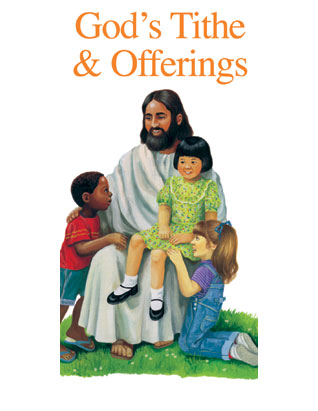
Expressing our Love for Christ

Every man according as he purposeth in his heart, so let him give; not grudgingly, or of necessity: for God loveth a cheerful giver. 2 Corinthians 9:7

Soviet Pastor Richard Wurmbrand, the author of Tortured for Christ, suffered terribly for the Lord. Yet he said that even while in prison, he saw fellow Soviet believers practice generous giving. “When we were given one slice of bread a week and dirty soap every day, we decided we would faithfully ‘tithe’ even that. Every tenth week we took the slice of bread and gave it to the weaker brethren as our ‘tithe’ to the Master.”

I tend to think that God did not demand that these prisoners tithe their bread and soap. Yet they felt compelled to, in order to express their love for God. After understanding the awesome sacrifice Christ had made in expressing His love for them on the cross, they wanted a way to express their love for Christ. They wanted to give all of themselves to Christ since He had given all of Himself for them.

It is the same case with the woman in Mark 14:3-9, who broke open a bottle of ointment costing a year’s wages, so she could anoint the feet of Jesus. She was simply giving all she had because Jesus was giving all He had for her. Like the Soviet prisoners she needed a way to express her love.

God did not give us the tithe and offering system because he needed our money, but because He knew we too would need a way to express our love. God nor the church needs our money. Both were getting along just fine before we came along and both will do just fine after we are gone.

I have a plaque with a picture of the cross and written on it are the words,

“ I asked Jesus how much do you love me?”

“This much” He said, ’Then He spread out His arms and died.”

God will finish the work with or without our money. Yet He has given us the tithe and offering system so that when He asks us, “How much do you love me?” We will have a way to answer.

You may study this week’s lesson here.

4: Offerings for Jesus-Sabbath School Lesson Teaching Plan

Prepared by William Earnhardt for Sabbath school class, January 28, 2023.

Main Theme: We worship God by using all our time and resources for God.

Read in Class: Deuteronomy 16:7. Discuss the main idea of this passage.

Study: What criterion does God give as a basis for the amount of our offerings?

Apply: What do your offerings and your attitude about giving them say about your relationship with God?

Share: Your friend says he only returns tithes but cannot give offerings because tithe is all he can afford to do. Anything else is just asking too much. What do you tell your friend?

Read in Class: 1 Chronicles 16:29 and Psalm 96:8-9. Define the common thread of these passages.

Study: How do we apply these principles to our own worship experience?

Apply:  What is your experience with returning tithes and offerings as a part of worship? How does it impact your relationship with God?

Share: Your friend says, “God never said anything about offerings being required, but only as an expression of thanksgiving based on our increase. God doesn’t need my money. He can finish the work without all the expensive programs the church makes up to increase their income and finances.” How would you respond to your friend?

Read in Class: Mark 12:41-44 and Acts 10:1-4. Define the common thread of these passages.

Study: What is the message of these stories, and how can we apply it to our own worship experience?

Apply: What action was noted in heaven by the Roman that prompted a visit from heaven? Share your thoughts.

Share: Your friend asks in what ways did the poor woman give more than they all? What do you tell your friend? Think about all the people who have given what little they can throughout the years, because of this woman’s story. Could all of that add up to more than the rich gave that day?

Read in Class: Mark 14:1-9. What is the main theme of this passage?

Study: Who were the main characters at Simon’s feast? What was the value of Mary’s gift? Why did she anoint Jesus at this time?

Apply: Why is sacrificial giving as important for the givers as for the recipients? 

Share: Are there any specific needs in the church that your Sabbath school class could raise money to contribute towards?

How to Find Your Increase for Tithes and Offerings

Thou shalt truly tithe all the increase of thy seed, that the field bringeth forth year by year. Deuteronomy 14:22 KJV

Tithing on your “increase” is different than tithing on your “gross” or “net” as an employee. This affects people who are self-employed and/or invest in their business. An illustration I use when giving a Bible study on tithing is that, if you get paid $50.00 for mowing your neighbor’s lawn and you paid $5.00 for the gas, then you actually made $45.00. $45.00 is your increase or profit. You would tithe on the $45.00 since that is what you actually made. By the way, the $45.00 is what you would also pay taxes on, so both God and “Caesar” realize you made $45.00, and not $50.00.

Of course there could be other expenses too, like the cost of the lawn mower, but I think you get the gist of the illustration. Of course the cost of the lemonade you bought from the stand across the street would not count as a business expense because even though it quenched your thirst, it was not a direct business expense.

I’ll give several other examples, as I see them, and I encourage our readers to contribute their examples.

Now “Caesar” realizes if you work in an office or campus, that driving to work and back is not a direct investment to your business. You do not write off travel expenses to work and back. However, you do write off driving expenses while working. For example if I’m a courier doing deliveries, I would deduct travel expenses from what I am paid to find my actual profit, and then tithe and pay taxes on the actual profit. By the way, your gross income would be considered your actual profit. Let’s say I pick up a kayak in Sydney and drive 170 kilometers to deliver the kayak in Newcastle, for $525. To find my profit I would subtract 66 cents a km, which would be $112, leaving me with a profit of $413. I would tithe on the $413, which would be $42 (rounded up). Of course I can round that up to $45.00 or even $50.00!

Now, if I drove 10 kilometers to make the pickup in Sydney I would not count that against my profit because that was just getting to work. It was not an expense of the actual work itself. The way I see it, only things that you invested directly to making your profit would be deducted from your profit. Now if I traveled from my home to a courier training workshop in Melbourne, that would be a travel expense relating directly to my business and profit. Everyone needs to decide between themselves and God if something is a direct business expense.

Again, your profit is counted as your gross income which you would be taxed on and would tithe on. Sometimes when I am giving this study, people will ask me if they can deduct their home electric bill from their gross income and then tithe after that. The answer is “no.” Your home electric bill is not a part of your business or an investment in your profit. “Caesar” does not let you write off your home electric bill as it has nothing to do with your profit if you are not working at home.

You need to follow your own conscience and Bible principles on determining what your increase is, but as a general rule, if “Caesar’ sees an item as a business expense then it is reasonable to count it as a business expense regarding your increase (profit) and tithe. Remember we do not pay tithe. We return tithe. We are returning to God what is already His with thanksgiving for all the many ways He cares for us. We also want to give a generous offering in addition to our tithe, with a cheerful heart knowing we can never outgive or out love God. 

I hope this conversation has been helpful, and we can discuss it further in the comment section.

You may study this week’s Sabbath School lesson here.

3: The Tithing Contract-Sabbath School Lesson Teaching Plan

Photo by Karolina Grabowska on Pexels.com

Prepared by William Earnhardt for Sabbath School class, January 21, 2023.

Main Theme: Giving is the very nature of God and those who belong to Him.

Read in Class: Genesis 14:18-20 and Hebrews 7:1-9. What is the common thread of these passages?

Study: What was Abram’s response to meeting Melchizedek? What does this teach us about how far back in history the practice goes?

Apply: Why is it important to understand that tithing, like the Sabbath, was not something that originated in the ancient Israelite legal or even religious system? What message should we, who live after the cross, take from this truth?

Share: Your friend tells you tithing is only an Old Testament practice. What do you tell your friend? See 1 Corinthians9:13-14 and Matthew 23:23.

Read in Class: Leviticus 27:30 and Numbers 18:21,24. Define the common thread of these passages?

Study: What does God propose to do with the tithe?

Apply: Acts 20:35 says it’s more blessed to give than to receive. How has God bless you by returning your tithes and offerings?

Share: Your friend says pastors are lazy and only work one day a week. They do not deserve to be paid. What do you tell your friend?

Read in Class: 1 Kings 17:9-16. Define the main idea of this passage.

Study: What was the widow’s situation before Elijah came to her? What did the prophet ask her to do first before taking care of herself and her son? What can we learn from this about putting God first in our giving?

Apply: Salvation is by faith and trusting in Jesus. How does returning tithes and offerings reveal how you trust Jesus?

Share: Your friend says he does not have the money to tithe now, but will later when he gets more money. What do you tell your friend?

Read in Class: 1 Corinthians 4:1-2 and Matthew 25:19-21.

Study: When are we called upon to give an account of our management of God’s funds? What is said to those who have been financially faithful?

Apply: How faithful have you been in your giving? Could Jesus say to you today, “Well done thou good and faithful servant?”

Share: What other ways can you support pastors and Bible workers in your area besides making sure they have a decent salary? Can you reach out to your local pastors and Bible workers this week and let them know you appreciate them and are praying for them? Maybe even pray with them?

What Does Tithing on Your Increase Mean?

Photo by Suzy Hazelwood on Pexels.com

Thou shalt truly tithe all the increase of thy seed, that the field bringeth forth year by year. Deuteronomy 14:22 KJV

Tithing on your “increase” is different than tithing on your “gross” or “net” as an employee. This affects people who are self-employed and/or invest in their business. An illustration I use when giving a Bible study on tithing is, that if you get paid $50.00 for mowing your neighbors lawn, and you paid $5.00 for the gas, then you actually made $45.00. $45.00 is your increase or profit. You would tithe on the $45.00 since that is what you actually made. By the way the $45.00 is what you would also pay taxes on, so both God and “Caesar” realize you made $45.00, and not $50.00.

Of course there could be other expenses too, like the cost of the lawn mower, but I think you get the gist of the illustration. Of course the cost of the lemonade you bought from the stand across the street would not count as a business expense because even though it quenched your thirst, it was not a direct business expense.

I’ll give several other examples, as I see them, and I encourage our readers to contribute their examples.

Now “Caesar” realizes if you work in an office or campus, that driving to work and back is not a direct investment to your business. You do not write off travel expenses to work and back. However you do write off driving expenses while working. For example if I’m a courier doing deliveries, I would deduct travel expenses from what I am paid to find my actual profit, and then tithe and pay taxes on the actual profit. By the way your gross income would be considered your actual profit. Let’s say I pick up a kayak in Sydney and drive 170 kilometers to deliver the kayak in Newcastle, for $525. To find my profit I would subtract 66 cents a km, which would be $112, leaving me with a profit of $413. I would tithe on the $413, which would be $42 (rounded up). Of course I can round that up to $45.00 or even $50.00!

Now if I drove 10 kilometers to make the pickup in Sydney I would not count that against my profit because that was just getting to work. It was not an expense of the actual work itself. The way I see it, only things that you invested directly to making your profit would be deducted from your profit. Now if I traveled from my home to a courier training workshop in Melbourne, that would be a travel expense relating directly to my business and profit. Everyone needs to decide between themselves and God if something is a direct business expense.

Again, your profit is counted as your gross income which you would be taxed on and would tithe on. Sometimes when I am giving this study, people will ask me if they can deduct their home electric bill from their gross income and then tithe after that. The answer is “no.” Your home electric bill is not a part of your business or an investment in your profit. “Caesar” does not let you write off your home electric bill as it has nothing to do with your profit if you are not working at home.

You need to follow your own conscience and Bible principles on determining what your increase is, but as a general rule, if “Caesar’ sees an item as a business expense then it is reasonable to count it as a business expense regarding your increase (profit) and tithe.

I hope this conversation has been helpful, and we can discuss it further in the comment section.

You may study this week’s Sabbath School Lesson here.

2: God’s Covenants With us-Sabbath School Lesson Teaching Plan

Prepared by William Earnhardt, For Sabbath School Class January 14, 2023.

Main Theme: Our responses to God’s promises determines if they are fulfilled for us.

Read in Class: 1 John 5:13, Matthew 10:22 and 2 Peter 1:10-11. Define the common thread in these passages.

Study: How do these passages say we receive the gift of salvation?

Apply: Though salvation is an unmerited gift, what’s the difference between those who accept the gift and those who don’t? What does accepting this gift require that we do?

Share: Your friend tells you she believes on once saved always saved. She believes there is no way a saved person can lose salvation. Using Scripture, what do you tell your friend?

Read in Class: Deuteronomy 28:1-14. Define the main idea of this passage.

Study: What great blessings are promised the people? But what must they do to receive them?

Apply: What does it mean for us, today, to “hearken diligently” to what God tells us to do?

Share: Your friend tells you the book of Deuteronomy is in the Old Testament. We don’t have to obey, only believe. What do you tell your friend?

Read in Class: Proverbs 3:9-10 and Malachi 3:10-11. Define the common thread of these passages.

Study: What are the promises and the obligations found in these verses?

Apply: What does your tithing (or lack thereof) say about your own spirituality and relationship to God?

Share: Your friend says there is no way he can tithe and feed his family. He says God understands He can’t afford to tithe. What do you tell your friend? How could 1 Kings 17:8-16 help, Especially verse 13?

Read in Class: 2 Chronicles 7:14. Define the main idea of this passage.

Study: What are the “ifs” and “thens” of God’s proposal here?

Apply: What does it mean to “heal their land?” In what ways do we need healing today?

Share: Can you think of a friend or family member who is struggling with making a full commitment to Christ? Besides praying for them, is there any way you could speak a word of encouragement to them this week?

How to Fill out the Tithe Envelope

Photo by Anete Lusina on Pexels.com

Understandably, there are many who are unaware of the difference between tithes and offerings. Many, even seasoned members are surprised to learn there is a difference.

Tithe is not used for general use, like church maintenance, Sabbath School supplies and so on. The offerings cover those needs, while the tithe goes to pay the salaries of conference employed gospel workers. This is according to the direction of Scripture.

Behold, I have given the children of Levi all the tithes in Israel as an inheritance in return for the work which they perform, the work of the tabernacle of meeting. Numbers 18:21 NKJV

Do you not know that those who minister the holy things eat of the things of the temple, and those who serve at the altar partake of the offerings of the altar? Even so the Lord has commanded that those who preach the gospel should live from the gospel. 1 Corinthians 9:13-14 NKJV

The tithe goes straight to the ministry, while offerings are in addition to the tithe. Occasionally local church treasures will receive a tithe envelope that looks something like this,

Tithe: $200.00

Combined Budget: $100.00

Conference Evangelism: $100.00

Total: $200.00

The problem is the total should be $400.00. The person filling out the tithe envelope was thinking that he was to divvy up the tithe between the other categories on the envelope, but tithe is its own category. IF one is only returning their tithe, it should look like this,

Tithe: $200.00

Combined Budget:

Conference Evangelism:

Total: $200.00

If you are returning tithe and offering, it would look like this,

Tithe: $200.00

Combined Budget: $100.00

Conference Evangelism: $100.00

Total: $400.00

Scripture makes a distinction between tithes and offerings.

“Will a man rob God? Yet you have robbed Me! But you say, ‘In what way have we robbed You?’ In tithes and offerings. Malachi 3:8 NKJV 

So let each one give as he purposes in his heart, not grudgingly or of necessity; for God loves a cheerful giver. 2 Corinthians 9:7 NKJV

Malachi shows us tithe is in addition to the offering. 2 Corinthians 9:7 tells us while the tithe that goes to the ministry is 10% of our profit, the additional offering is what we purpose in our hearts.

My father was a church treasure for over 50 years, and would occasionally receive tithe envelopes filled out by those who thought the tithe was divided into the other categories on the offering envelope. Other treasures have mentioned it to me as well, though of course never mentioning names. Understanding how this can be confusing to some, when I give personal Bible studies on stewardship, I always make sure I carefully explain how the tithe is sacred to Gospel workers, and that the offerings are in addition to the tithe. I hope this explanation will be helpful to some.

By the way you can also contribute online to your local Adventist Church here.

You may study this week’s Sabbath School lesson here.

1: Part of God’s Family-Sabbath School Lesson Teaching Plan

Photo by Monstera on Pexels.com

Prepared by William Earnhardt, for Sabbath School Class, January 7, 2023.

Main Theme: Being a part of God’s family is both a privilege and a responsibility.

Read in Class; Psalm 50:10-12 and Psalm 24:1. What is the common thread of these passages?

Study: What’s the message here, and what should this truth mean to us and how we relate to whatever we possess?

Apply: “But who am I, and who are my people, that we should be able to offer so willingly as this?” (1 Chron. 29:14, NKJV). What beautiful principles are expressed in these words, and how do they reflect what our attitude toward God should be and our attitude toward what we possess?

Share: Your friend tells you the story about a great swarm of locusts devouring several farmer’s crops. At the town square one farmer complains to another farmer. The other farmer responds, “If God wants His locusts eating His crops that’s His business.” What did the other farmer mean by that? Do you agree with the other farmer?

Read in Class: Psalm 23:1, Psalm 37:25 and Philippians 4:19. What is the common thread in these passages?

Study: What do these verses say about God’s provision for our daily needs?

Apply: How has God taken care of your daily needs? Do any examples stand out in your mind about how He has provided for you?

Share: Your friend tells you they never bring anything to fellowship lunch at church because they know God will provide. They also tell you they never give to the local church budget because the church will always be there with or without their offerings. What do you tell your friend?

Read in Class: Deuteronomy 6:5 and Matthew 22:37. What is the common thread of these passages?

Study: What does this mean, and how do we do it?

Apply: How have been blessed both temporally and spiritually by loving God?

Share: Your friend says she does not need to keep the commandments. She only needs to love God. How do you respond to your friend?

Read in Class: Matthew 6:19-21. What is the main idea of this passage?

Study: What crucial truths is Jesus speaking here?

Apply: What have you been doing in the last month that reveals where your heart is? 

Share: Can you think of someone this week who is need of food, clothing or other resources? How can you help them in a practical way this week?

14: All Things New- Sabbath School Lesson Teaching Plan

Prepared by William Earnhardt, for Sabbath School class, December 31, 2022.

Main Theme: One day our hope of eternal life on the new earth will become reality.

Read in Class: Isaiah 65:17-25; Isaiah 66:22, 23; 2 Peter 3:13; and Revelation 21:1-5. What is the common thread of these passages?

Study: What is the ultimate message of these passages?

Apply: Many secular writers, without the hope of eternity as presented in Scripture, have lamented the meaninglessness of human existence. Though they are wrong about the future, why is it hard to argue with their point about the meaninglessness of life without a future hope?

Share: You friend asks, what we will be doing in heaven all eternity? Won’t it get boring? What things will be similar to our lives now? What will be different? What do you tell your friend?

Read in Class:  Revelation 7:9-15 with Revelation 21:3, 22. What is the common thread of these passages?

Study: How can we harmonize the description of the great multitude of the redeemed serving God “day and night in His temple” (Rev. 7:15, NKJV) with the statement that John “saw no temple” in the New Jerusalem (Rev. 21:22, NKJV)?

Apply: Revelation 21:3 reads: “Behold, the tabernacle of God is with men, and He will dwell with them, and they shall be His people. God Himself will be with them and be their God” (NKJV). These verses reflect numerous other passages (Jer. 32:38, Ezek. 37:27, Zech. 8:8, Heb. 8:10). What does it mean for us now, still here on earth, that God will be our God, and we will be His people? How do we live out this amazing truth now?

Share: Your friend asks, Isn’t God already with us now? In what ways is God already with us? How will it be different in the new earth? What do you tell your friend?

Read in Class:  Matthew 5:8; 1 John 3:2, 3; and Revelation 22:3, 4. What is the common thread of these passages?

Study: What do these passages tell us about the supreme privilege of seeing God?

Apply: Read 1 Peter 1:22. How does this text reveal to us the link between obedience and purification? What is it about obedience that purifies us? How, specifically, does Peter say our obedience will be made manifest?

Share: Your friend’s child asks you, if God is real why can’t we see Him? What do you tell your friend’s child?

Read in Class:  Isaiah 25:8, Revelation 7:17, and Revelation 21:4. What is the common thread in these passages?

Study: What comfort and hope can these passages bring us amid the trials and suffering of this present world?

Apply: Who hasn’t felt the unfair ravages of human existence here? Especially in those bad times, how can we learn to trust, and to the degree possible, rejoice in God’s goodness and love?

Share: Can you think of someone who would be encouraged by some things found in this week’s lesson. How can you plan to share it with them this week?