There is a lot of Gospel Theology Packed Into Genesis 3!

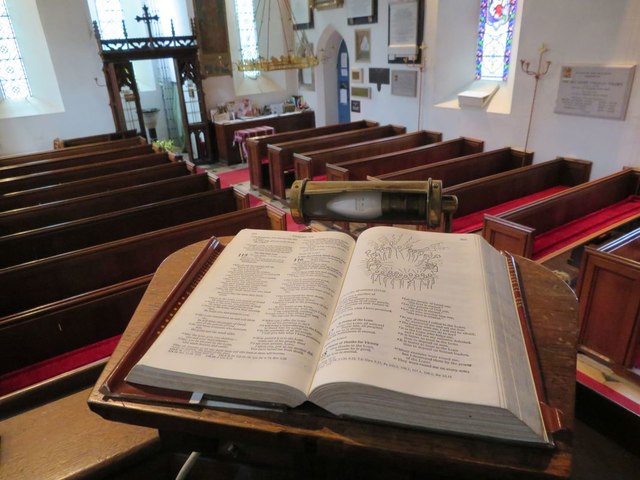
Bible on the pulpit by Bill Nicholls is licensed under CC-BY-SA 2.0

As we study Genesis 3 and the fall in this week’s Sabbath School lesson, I am amazed how much Gospel theology is packed into this one chapter. 

In Genesis 3 we find The Plan of Salvation.

The wages of sin is death.

but of the fruit of the tree which is in the midst of the garden, God has said, ‘You shall not eat it, nor shall you touch it, lest you die.’ ” Genesis 3:3 NKJV

We cannot cover our own sin or be saved by our own works.

Then the eyes of both of them were opened, and they knew that they were naked; and they sewed fig leaves together and made themselves coverings.

So he said, “I heard Your voice in the garden, and I was afraid because I was naked; and I hid myself.” Genesis 3:7,10 NKJV

While we cannot save ourselves, God has promised us a Savior.

And I will put enmity Between you and the woman, And between your seed and her Seed; He shall bruise your head, And you shall bruise His heel.” Genesis 3:15 NKJV

While we cannot cover or save ourselves Jesus, the Lamb of of God died to cover our sins and save us.

Also for Adam and his wife the Lord God made tunics of skin, and clothed them. Genesis 3:21 NKJV

In Genesis 3 we find the truth about God’s Word.

While Eve reminds the serpent of God’s Word the serpent casts doubt on God’s word at first, and then turns around and calls God’s Word an outright lie. 

Now the serpent was more cunning than any beast of the field which the Lord God had made. And he said to the woman, “Has God indeed said, ‘You shall not eat of every tree of the garden’?”  And the woman said to the serpent, “We may eat the fruit of the trees of the garden; but of the fruit of the tree which is in the midst of the garden, God has said, ‘You shall not eat it, nor shall you touch it, lest you die.’ ” Then the serpent said to the woman, “You will not surely die. Genesis 3:1-4 NKJV

The serpent then suggests that Eve does not need God’s Word. She can be a god herself and decide for herself what is right and wrong.

For God knows that in the day you eat of it your eyes will be opened, and you will be like God, knowing good and evil.” Genesis 3:5 NKJV

The serpent assures Eve she won’t die for disobeying God. After all, how dare God tell us what is right and wrong, much less give us consequences for having our own opinions and way of doing things! The Serpent tells Eve she will be like God. God makes the rules. God is the judge between right and wrong. If Eve becomes like God she will make the rules and decide for herself what is right and wrong. This was implied in the serpent’s comment to Eve, “you will know both good and evil.” In other words,

She would be a god. She would be a law unto herself. –Ellen White, Christ Triumphant, January 16.

Even with all the deceptions and misrepresentations God’s Word proves true. Adam and Eve died for disobeying.

For dust you are, And to dust you shall return. Genesis 3:19 NKJV 

In Genesis 3 we find the truth about death. 

the serpent’s lie opens the door for spiritualism. 

Then the serpent said to the woman, “You will not surely die.” Genesis 3:4 NKJV

We see that mankind really does die and just returns to dust until the resurrection.

For dust you are, And to dust you shall return. Genesis 3:19 NKJV 

We see that sinners do not have immortality and do not get to live forever.

Then the Lord God said, “Behold, the man has become like one of Us, to know good and evil. And now, lest he put out his hand and take also of the tree of life, and eat, and live forever”— Genesis 3:22 NKJV

We see that angels are not our dead loved ones. We do not become angels when we die. God sends Cherubim angels to guard the garden and yet no one has died yet. Angels are not our dead loved ones. 

So He drove out the man; and He placed cherubim at the east of the garden of Eden, and a flaming sword which turned every way, to guard the way to the tree of life. Genesis 3:24 NKJV.

In Genesis 3 we find an investigative judgment. 

Many throw shade on the Biblical teaching of the investigative judgment, saying God does not need to investigate since He already knows everything. Yet we see an investigation in Genesis 3 even though God already knew everything. Remember the investigation is not for God only. He is offering accountability to the entire universe. At the conclusion of the investigative judgment in Genesis 3 and at the end of days, believing mankind will be justified and Satan will bear the ultimate responsibility for and punishment for sin.

And He said, “Who told you that you were naked? Have you eaten from the tree of which I commanded you that you should not eat?” Then the man said, “The woman whom You gave to be with me, she gave me of the tree, and I ate.” And the Lord God said to the woman, “What is this you have done?” The woman said, “The serpent deceived me, and I ate.” So the Lord God said to the serpent: “Because you have done this, You are cursed more than all cattle, And more than every beast of the field; On your belly you shall go, And you shall eat dust All the days of your life.  And I will put enmity Between you and the woman, And between your seed and her Seed; He shall bruise your head, And you shall bruise His heel.” Genesis 3:11-15 NKJV

Did I miss anything? Can you find anymore Gospel theology in Genesis chapter 3? 

2: The Fall-Sabbath School Lesson Teaching Plan

Prepared by William Earnhardt, for Sabbath School class, Sabbath, April 9, 2022.

Main Theme: As soon as mankind fell, God provided a Savior.

Read Together: Genesis 3:1-7. Discuss the main idea of this passage.

Study: What tactics did the serpent use to get Adam and Eve to fall?

Apply: If Satan could get Adam and Eve to fall, how easy it must be for us to fall? What is our defense against temptation? See Every Word of God Proves True. See also What Role Does the Bible Play in a World Where Everyone Does Whatever is Right in Their Own Eyes?

Share: Your friend asks you why in Romans 5 it talks about sin coming through Adam, when in reality Eve sinned first? What do you tell your friend? See 1 Timothy 2:14. What does this tell us about God only holding us accountable for what we know?

Read Together: Genesis 3:8-20. Discuss the main idea of this passage.

Study: What was the purpose of this “investigative judgment?” Did God not already know what Adam and Eve had done?

Apply: As soon as Adam and Eve were caught, they started pointing the finger. Why do we blame others for our mistakes, and how does pointing the finger and blaming others keep us from experiencing full salvation? See 2 Samuel 12:1-7. , Romans 2:1-4. See also John 5:1-8.

Share: A friend says, “Sin and suffering is all God’s fault. He never should have placed the tree of knowledge of good and evil in the garden with Adam and Eve.” How do you respond to your friend?

Read Together: Genesis 3:7, 21. Discuss the main idea of these passages.

Study: What was Adam and Eve’s solution for their sin and nakedness? What was the Lord’s solution? How does this relate to works and grace?

Apply: In light of these two verses, how is the way we clothe ourselves related to our salvation? See Luke 8:27,35.

Share: A friend states, “Adam and Eve tried to save themselves by their works by making a garment of fig leaves, but how could we be trying to save ourselves by our own works today? How do we know we are really trusting the Lamb of God to clothe us?” How do you respond to your friend?

Read Together: Genesis 3:15, Romans 16:20, Hebrews 2:14, and Revelation 12:17. Define the common idea in these passages.

Study: How is the plan of salvation, as well as the great controversy, revealed in these texts?

Apply: Why is it so comforting to see that, in Eden itself, where sin and evil on earth began, the Lord started to reveal the plan of salvation?

Share: Can you think of someone this week who needs to hear the plan of salvation? Can you share it with them this week?

“No sooner does one come to Christ than there is born in his heart a desire to make known to others what a precious friend he has found in Jesus;” –Steps to Christ, Page 78.

13: Let Brotherly Love Continue-Sabbath School Teaching Plan

Photo by Monstera on Pexels.com

Prepared by William Earnhardt, for Sabbath School class Sabbath, March 26, 2022.

Main Theme: Hebrews teaches us how to live a practical Godly life with Jesus as our High Priest and intercessor.

Read Together: Hebrews 13:1-2, Romans 12:13, 1 Timothy 3:2, Titus 1:8 and 1 Peter 4:9. Define the main idea of these passages.

Study: What is the role of hospitality in the church?

Apply: What more can we do for those who are in prison, whether church members or not?

Share: Your friend opposes the church’s prison ministry because many of the prisoners are con artists and instead of being sincere are only looking to take advantage of people. How do your respond to your friend?

Read Together: Hebrews 13:4-5. Define the main idea in this passage.

Study: What two evils are found in the passage, how could they be tied together?

Apply: What are the ways that contemporary society undermines sexual purity and, at the same time, feeds the human love of money? In what practical ways can we strengthen our defenses against these two dangerous vices?

Share: Your single friend confides how hard it is to stay sexually pure. He/she believes its easier to stay pure if you are married? How would you use this passage to help your single friend? See also Overcoming Sexual sin When you are Single.

Read Together: Hebrews 13:7-17. Define the main idea of this passage.

Study: What should be our relationship with our leaders?

Apply: What can you do to strengthen or improve the leader-member relationship in your congregation, as well as with leaders around the world?

Share: How do you encourage your friend who has a narcissistic pastor?

Read Together: Hebrews 13:9, 2:9, 4:16. Define the main idea of these passages.

Study: Where is grace obtained? How are our hearts strengthened?

Apply: Dwell on Christ’s complete sacrifice. Why, then, is the idea of anything that we do “adding” to this sacrifice contrary to the gospel and the grace that is found in Jesus?

Share: Can you think of someone who may be shut in or lonely who needs to be shown brotherly love? Can you reach out to them this week or even find a way to reach out to them every week?

Then the King will say to those on His right hand, ‘Come, you blessed of My Father, inherit the kingdom prepared for you from the foundation of the world:  for I was hungry and you gave Me food; I was thirsty and you gave Me drink; I was a stranger and you took Me in;  was naked and you clothed Me; I was sick and you visited Me; I was in prison and you came to Me.’ “Then the righteous will answer Him, saying, ‘Lord, when did we see You hungry and feed You, or thirsty and give You drink? When did we see You a stranger and take You in, or naked and clothe You?  Or when did we see You sick, or in prison, and come to You?’ And the King will answer and say to them, ‘Assuredly, I say to you, inasmuch as you did it to one of the least of these My brethren, you did it to Me.’ Matthew 25:34-40 NKJV

What’s the Difference Between Faith and Presumption?

In 2017 hurricane Irma came through Florida, and many of us evacuated. I went to Tennessee to stay with my sister. The morning the hurricane hit Tampa where I live, I received a text from a friend there who was unable to evacuate. She said she was afraid, but she knew God was with her and that she would not get hurt. I thought to myself that God was with my mother when she drew her last breath and died. Of course, I did not text my friend back and tell her that God has been with many people while they drew their last breath. In other words, just because God is with us does not mean we won’t die in a hurricane. By faith I know God is with me in a storm, but only presumption would tell me I won’t die in the storm. People a lot more righteous and godly than me have died in storms, while I am still alive.

Just because God is with us does not mean we won’t die. When a storm comes, having faith that God is with me is one thing, but having faith that I will not die is presumption. After all, millions of people have died in various storms throughout earth’s history. I would have to be a blatant fool to think I’m a better Christian than millions of other people or even that I have more faith than those who have died in storms.

It’s the same when I get in a car. I pray for safety, and I know God is with me. I also know I have heard testimonies from people who survived a car accident where a loved one died. They say they too prayed for protection before their trip. A pastor friend of mine was killed in a car accident just a few Christmases ago. He was in his forties. Am I still alive because I am a better Christian than he was or because I have more faith? Of course not! To think I have survived storms and car accidents because I am a faithful Christian is beyond presumption. It is absurd! Millions more worthy than me have perished in storms and car accidents. I know God is with me regardless of my fate. While Hebrews celebrates the victories of the faithful it also recognizes the deaths of the faithful.

Others were tortured, not accepting deliverance, that they might obtain a better resurrection. Still others had trial of mockings and scourgings, yes, and of chains and imprisonment. They were stoned, they were sawn in two, were tempted, were slain with the sword. They wandered about in sheepskins and goatskins, being destitute, afflicted, tormented— of whom the world was not worthy. They wandered in deserts and mountains, in dens and caves of the earth. Hebrews 11:35-38 NKJV

Faith is knowing what God has promised. God has promised me eternal life. See Titus 1:2. Presumption is assuming what God has not promised. God never promised me I would never die in a storm or car accident.

So now let’s get to the title of our topic here. How do I know I have the assurance of salvation in Jesus and am not just being presumptuous that I am saved? Let’s take a look at some biblical examples of people in the Bible who were being faithful and those who were just being presumptuous.

But someone will say, “You have faith, and I have works.” Show me your faith without your works, and I will show you my faith by my works. You believe that there is one God. You do well. Even the demons believe—and tremble! But do you want to know, O foolish man, that faith without works is dead? James 2:18-20 NKJV

In the book of James we are taught that true faith will bear the fruits of good works and obedience. “Faith” that does not bring forth good works and obedience is a presumption which will not make us any better off than the demons who believe and tremble.

Now God worked unusual miracles by the hands of Paul, so that even handkerchiefs or aprons were brought from his body to the sick, and the diseases left them and the evil spirits went out of them. Then some of the itinerant Jewish exorcists took it upon themselves to call the name of the Lord Jesus over those who had evil spirits, saying, “We exorcise you by the Jesus whom Paul preaches.” Also there were seven sons of Sceva, a Jewish chief priest, who did so. And the evil spirit answered and said, “Jesus I know, and Paul I know; but who are you?” Then the man in whom the evil spirit was leaped on them, overpowered them, and prevailed against them, so that they fled out of that house naked and wounded. Acts 19:11-16 NKJV

The sons of Sceva were presumptuous because they did not know Jesus for themselves. By the way, 1 John 2:4 says if we say we know Jesus but do not obey the commandments that just makes us liars. We know they did not know Jesus for themselves because they said. “The Jesus whom Paul preaches.” Paul knew Jesus. They did not. They were being presumptuous, thinking the name of Jesus was a magic word like abracadabra. Jesus and Paul are not magic. They both got their power from an obedient relationship with the Father.

In Numbers 10:33-35 Moses sent the ark out before their battles and victories. However when Israel was in apostasy their faith in the ark turned into presumption, and the ark itself was captured by the enemy in 1 Samuel 4:1-22. The ark was not magic. The ark was a symbol of their faith and obedience toward God. Without obedience the ark had no power for them – much like Samson’s hair. There was no magic in his hair. His long hair was a sign of his loyalty to God. When he was no longer loyal to God, the long hair was meaningless. See Judges 13:5.

Romans 1:5 talks about faith that leads to obedience, and Revelation 14:12 tells us God’s last-day saints will have faith and keep the commandments. True biblical faith produces obedience. A supposed “faith’ without obedience is mere presumption. In Matthew 4:5-7 Satan tells Jesus to jump off a tower and have faith that God would save Him. However there is no command from God to jump off a tower. Jesus knew that jumping off the tower would not be in accordance with God’s commands and would not be an obedient faith but mere presumption. By the way, today we wear seat belts in our cars because, while we have faith in God, we were given no command to be careless and presumptuous with our safety. Jesus gave us an example of using common sense and faith in God at the same time. One does not cancel out the other.

By faith the walls of Jericho fell down after they were encircled for seven days. Hebrews 11:30 NKJV

But a few days later the children of Israel were defeated when disobedience led to presumption. See Joshua 7:1-26.

While Romans 1:5 and Revelation 14:12 talk about faith and obedience David links presumption with sin.

Keep back Your servant also from presumptuous sins; Let them not have dominion over me. Psalm 19:13 NKJV

Faith is when we claim a promise in the Bible, such as that God is with us. Presumption is when we claim assurance the Bible never gave us such as I will never die in a storm or car accident. Or even that I will never get COVID-19 therefore I do not need to take precautions. In the wilderness Jesus used faith and common sense, and so shall I.

Faith leads me into good works. See Ephesians 2:8-10. Faith leads me into commandment keeping. See Revelation 14:12. Presumption encourages me to carelessness and sin. See Psalm 19:13.

Matthew 7:21-27 teaches me claiming salvation without obeying Jesus is mere presumption. When I put God’s Word into practice I have the assurance of salvation.

You may study this week’s Sabbath School Lesson here.

11: Jesus, Author and Perfecter of our Faith-Sabbath School Teaching Plan

Photo by RODNAE Productions on Pexels.com

Prepared by William Earnhardt, for Sabbath School class, Sabbath, March 12, 2022.

Main Theme: Hebrews 11 assures us of the many victories and accomplishments that can be ours through faith.

Read Together: Hebrews 10:35-39. Define the main thought of this passage.

Study: What is God saying to us in these verses?

Apply: Why is it important to recognize that our faith results from and feeds on God’s faithfulness? How can we learn more to trust in His faithfulness to us and to the promises He has made to us?

Share: Your nephew asks you what is the difference between faith and presumption? How do you answer your nephew? For ideas see Faith and Presumption.

Read Together: Hebrews 11:1-19. Define the main idea of this passage.

Study: What did these heroes of faith do that exemplified their faith?

Apply: Why is meditating on how God has led our lives in the past so crucial in maintaining our faith and trust in Him now?

Share: Your neighbor says that obedience is not important. The only thing that matters is that we have faith. How do you answer your neighbor? See Hebrews 11:8, James 2:21-24, and Genesis 26:5.

Read Together: Hebrews 11:20-28. Define the main idea of this passage.

Study: What did these men of faith do? How are their actions related to things not seen?

Apply: What are some of the struggles that you have faced because of your faith? What have you had to give up for it? Why, ultimately, is the reward worth it, even if you can’t see it now?

Share: Your relative says that one bird in the hand is worth two in the bush. Should Moses have really given up a sure thing, like being prince of Egypt for something that could only be grasped by faith? Wasn’t that risky? How do you answer your relative?

Read Together: Hebrews 12:1-4. Define the main idea of this passage.

Study: What do these verses ask us to do?

Apply: How is your endurance? Do you endure against temptation or give up easily? How can we have the victory?

Share: Can you think of someone who may be discouraged and need their faith lifted? Can you reach out to them this week with words of encouragement?

“Often He met those who had drifted under Satan’s control, and who had no power to break from his snare. To such a one, discouraged, sick, tempted, and fallen, Jesus would speak words of tenderest pity, words that were needed and could be understood. Others He met who were fighting a hand-to-hand battle with the adversary of souls. These He encouraged to persevere, assuring them that they would win; for angels of God were on their side, and would give them the victory. Those whom He thus helped were convinced that here was One in whom they could trust with perfect confidence. He would not betray the secrets they poured into His sympathizing ear. -Ellen White, Desire of Ages, Pages 91-92.

10: Jesus Opens the way Through the Veil-Sabbath School Teaching Plan

Prepared by William Earnhardt for Sabbath School class, Sabbath, March 5, 2022.

Main Theme: The book of Hebrews shows us how Jesus is working on our behalf in the heavenly sanctuary.

Read Together: Hebrews 9:24. What is the main idea of this passage?

Study:  According to this passage, what was the purpose of Jesus’ ascension to heaven?

Apply: Why should the reality of what Christ has done, not only on the cross but what He is doing now in heaven, give us assurance of salvation?

Share: Your friend shares that she thinks there is no real sanctuary in heaven. Christ is the actual sanctuary. How would you answer your friend’s claims?

Read Together: Leviticus 10:1-3, and Leviticus 16:1-2. Define the main idea of these passages.

Study: What warning do we have in these passages?

Apply: Matthew 27:51 tells us the veil of the earthly sanctuary was torn apart when Jesus was crucified. In Hebrews 4:14-16 it tells us to come boldly before the throne of grace in time of need. How does this veil being removed give you confidence to enter the presence of God today?

Share: Your friend asks you, if Jesus was God why weren’t people destroyed when they saw Him walk the earth, just like the Israelites were destroyed if the approached God on Sinai or the temple? How do you answer your friend? Hint: Hebrews 10:19-20.

Read Together: Hebrews 10:19-22. Define the main idea of this passage.

Study: What invitation do we have in this passage?

Apply: What accusations could Satan make against you before God, if He were allowed? Though he is a liar, how much would he have to lie about you in order to seek your condemnation? What’s your only hope?

Share: Your friend asks, “What does it mean to be able to enter into the holiest through the veil through His flesh and blood by a new and living way? And what does it mean to have our hearts sprinkled and our bodies washed?” How do you answer your friend?

Read Together: Hebrews 12:22-24. What is the main idea of this passage?

Study: In what sense have we arrived at heavenly Jerusalem into the presence of God? See Ephesians 2:5-6 and Colossians 3:1.

Apply: How can we learn to make the promise of eternal life real to us now, amid a world so full of pain and suffering? What answer can you give to those who say that this is all just a fantasy to help us feel better about our life here and now?

Share: Your friend asks you how you know your name is registered in heaven? How do you answer your friend?

The precious Saviour will send help just when we need it. The way to heaven is consecrated by His footprints. Every thorn that wounds our feet has wounded His. Every cross that we are called to bear, He has borne before us. The Lord permits conflicts, to prepare the soul for peace.–The Great Controversy, p. 633. (1888)